

Surfacing in
Guildford
Period homes off the Hog's Back, new builds around the A3 corridor.
See work in Guildford→We will beat ANY like for like quotation. Contact us for more information.
Residential service
Hot-laid tarmacadam for long, hard-wearing driveways.
BeforeAfterBefore & after
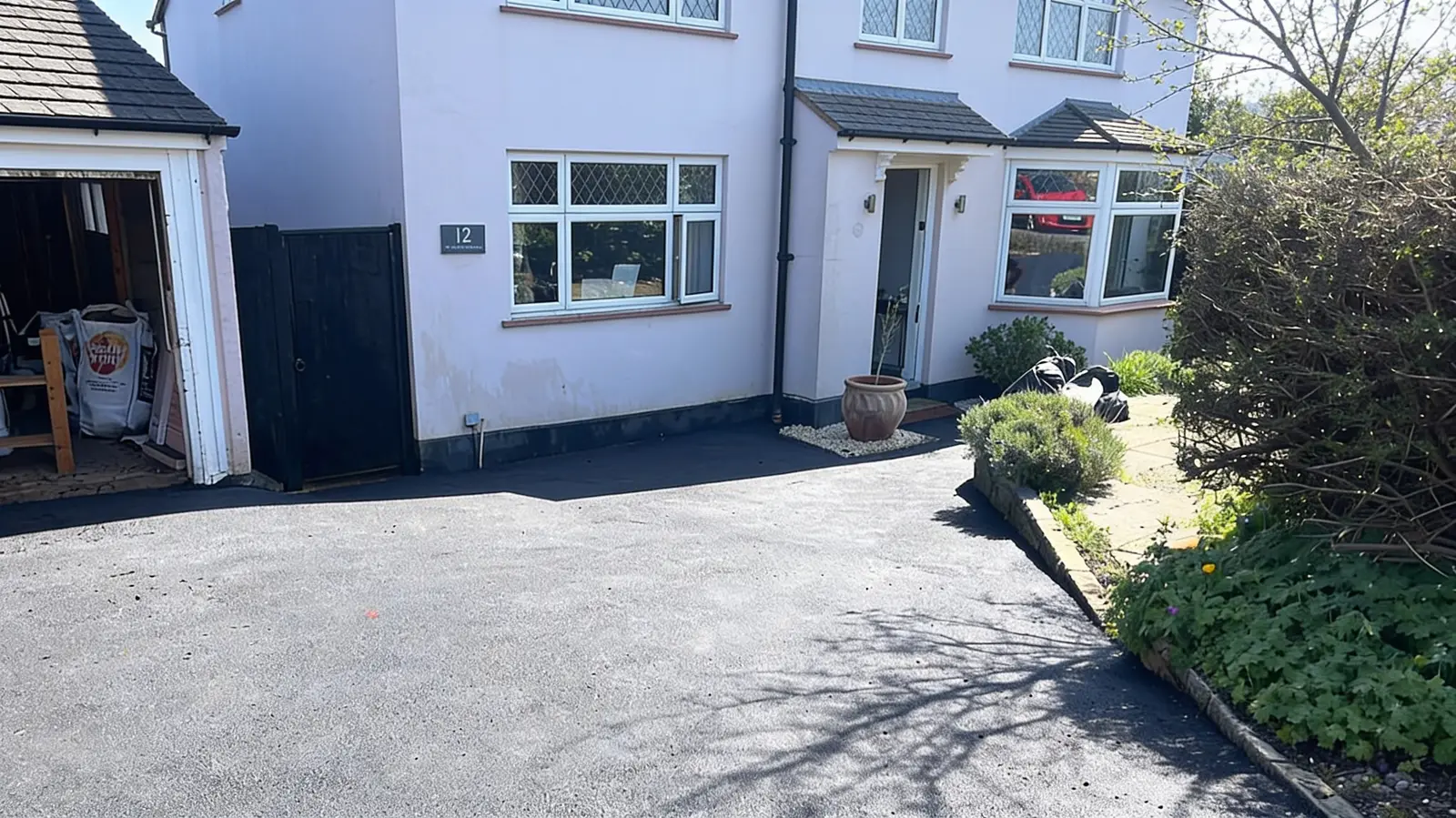
A smooth, hard-wearing tarmac driveway with no more patches or ponding — an even surface that lifts the whole frontage.
See the full projectWhat it is
Tarmac — more precisely, hot-rolled asphalt or dense bitumen macadam — is the most field-proven driveway surface in the country. It has been laid under British weather for over a century because it works: it bonds tightly when compacted hot, sheds water to where you direct it, handles the weight of vans and the abuse of skip lorries, and is easier and cheaper to repair than most alternatives when something eventually does go wrong.
The reputation tarmac has for failing early almost always comes from corners cut on depth and compaction, not from anything wrong with the material itself. A correctly built tarmacadam driveway — proper Type 1 MOT sub-base compacted in layers, a binder course of the right grade, and a surface course rolled at temperature — will stay flat and crack-free for well over a decade under normal residential use. A thin scrape of tarmac on whatever was already there, rolled with a wacker plate rather than a proper mechanical roller, will fail within two years. The two are priced differently because they are different products.
We hot-lay from our local asphalt plant, which means the material arrives at the right temperature and goes down within its workable window. We do not use cold-lay asphalt for driveways — it is a patching material, not a surface course, and the difference in compaction strength and long-term durability is significant.
Best for
Recent work
A selection of finished tarmac jobs — every one our own work.
Tarmac driveway · Kenley, Surrey
Tarmac driveway · Virginia Water
Tarmac driveway · Haslemere, Surrey
Tarmac driveway · Surrey
Tarmac driveway · Woking
How we work
We cut out to the depth needed for the ground conditions and the vehicle load — typically 150–200mm for cars, more if the soil is soft or there is regular van or commercial traffic. A Type 1 MOT granular sub-base is spread and compacted in 75mm layers using a vibrating plate or roller until we achieve a stable, even platform with the correct falls designed in.
Concrete or block kerbing is set and haunched before any asphalt is laid. Without a contained edge, tarmac creeps outward at the perimeter and crumbles within a few seasons. Any gullies or drainage channels are positioned and set to the correct level at this stage, before the binder course goes down.
Hot binder-course macadam — typically AC20 or AC14 close-graded, 60–70mm — is raked out and compacted immediately with a roller whilst the material is still within temperature. The binder course is the structural layer: it carries the load and provides the stable platform the surface course needs to bond to.
A 25–30mm surface course of AC10 close-graded macadam is laid over the binder, overlapping any joins, and compacted with a steel-drum roller in overlapping passes. Rolling continues until the surface is fully dense and any roller marks are worked out. The drive cools over the following hours and is typically ready for light traffic the same day.
Materials & spec
The failure modes are predictable and they all trace back to the same shortcuts. Edge crumble means the edging was skipped or laid after the asphalt instead of before it. Rutting under parked tyres means the surface course was too thin or the binder was not compacted properly whilst hot. Cracking across the middle of the drive usually means an inadequate sub-base that flexes under load. None of these defects show up on the day of installation — which is why they are so easy to sell around.
The things worth confirming in writing before any money changes hands: total depth of asphalt in millimetres (binder plus surface), sub-base depth and material type, whether a roller or plate compactor is used on the surface course, and how the edges are finished. A contractor who will not put these details in a written quote is a contractor with something to hide about one or more of them.
Standard tarmac is not permeable — water runs off the surface rather than through it. For a new or replacement driveway over 5 square metres under the General Permitted Development Order, you need to manage that runoff on your own land: a soakaway, a drainage channel to a planted border, or a fall to a permeable strip along the edge. We design this in at the quote stage because retrofitting drainage is significantly more disruptive and expensive than building it in from the outset.
Where genuine permeability is needed — usually for planning compliance on a larger new drive — porous asphalt surface courses are available. These require the correct open-graded sub-base to drain into, and the maintenance regime is different from standard tarmac (the surface voids can silt up over time). We will advise whether porous asphalt is the right answer for your specific site or whether conventional tarmac with designed drainage is the simpler and more durable solution.
See also
Comparing options? Have a look at the other services we offer alongside tarmac.
Residential
Marshalls and Bradstone block paving installed to BS 7533.
Residential
Permeable resin-bound aggregates, smooth and SuDS-compliant.
Residential
Bound or loose gravel with stable sub-base and edging.
Residential
Patching, re-jointing, re-sanding, and section replacement.
FAQ
Hot-laid tarmac is typically safe for light foot traffic within a couple of hours of rolling and ready for car parking by the end of the working day in normal temperatures. We advise waiting 48 hours before parking anything heavy — vans, caravans, skips — and a full 7 days before the surface achieves its final hardened state. In hot weather, avoid parking in the same spot repeatedly during the first couple of weeks, as tarmac softens slightly in high heat before it fully ages.
An overlay is possible if the existing surface is structurally intact — no subsidence, no large cracks, no soft spots — and if there is adequate clearance at the threshold and garage door to allow the additional depth. Where the existing base is failing, an overlay simply delays the problem. We assess this at the site visit and give you an honest recommendation. We would rather advise a full build than take payment for an overlay that fails in 18 months.
Coloured tarmac uses the same bitumen macadam mix with a mineral or iron-oxide pigment added to the aggregate. The structural properties are identical to standard black. Red is often used to differentiate driveways from roads on shared or commercial access, and buff or brindle blends can soften the contrast with a brick or stone house front. The colour does fade gently over years as the surface oxidises, which is normal and expected.
Standard tarmac is very low maintenance. Keep the edges clear of soil and vegetation — roots and soil creep can undermine the edge restraint over time. Deal with oil spills promptly because prolonged petroleum contact softens bitumen. If cracks appear, fill them before water gets in and freezes. A professional surface dressing every 10–15 years refreshes the wearing surface and extends life considerably without the cost of a full overlay.
Yes — tarmac handles slopes well and is commonly used on stepped or ramped access drives. The critical consideration on a steep slope is drainage: falls need to be designed so that water is directed away from the house and does not sheet straight down the drive towards the road. Edge channels or a valley gutter at the base of the slope are usual solutions. We factor gradient into the specification and drainage design at quote stage.
Tell us where you are and roughly what you'd like done. Free site visit, written quote, no pressure.
We also work in
Surfacing in
Period homes off the Hog's Back, new builds around the A3 corridor.
See work in Guildford→Surfacing in
From Hook Heath driveways to commercial yards near Sheerwater.
See work in Woking→Surfacing in
Stoke D'Abernon homes and the Fairmile estates.
See work in Cobham→Surfacing in
St George's Hill and Burwood Park resin and block paving.
See work in Weybridge→Surfacing in
Claygate, Hinchley Wood, and Esher village driveways.
See work in Esher→Surfacing in
Conservation areas and rural plots around the town.
See work in Farnham→