

Surfacing in
Guildford
Period homes off the Hog's Back, new builds around the A3 corridor.
See work in Guildford→We will beat ANY like for like quotation. Contact us for more information.
Commercial service
Adopted and unadopted roads, NRSWA-compliant.
 BeforeAfter
Before & after
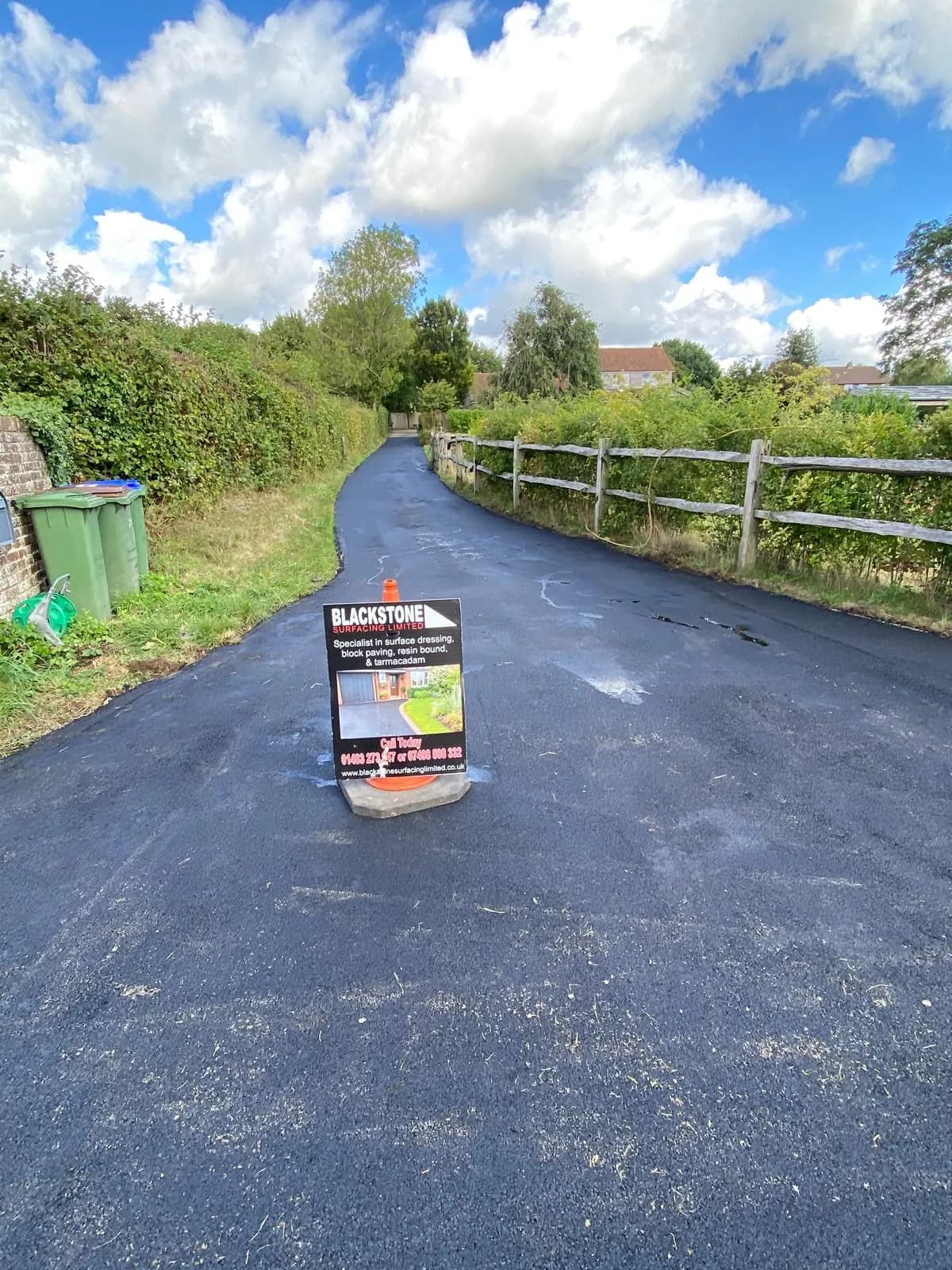
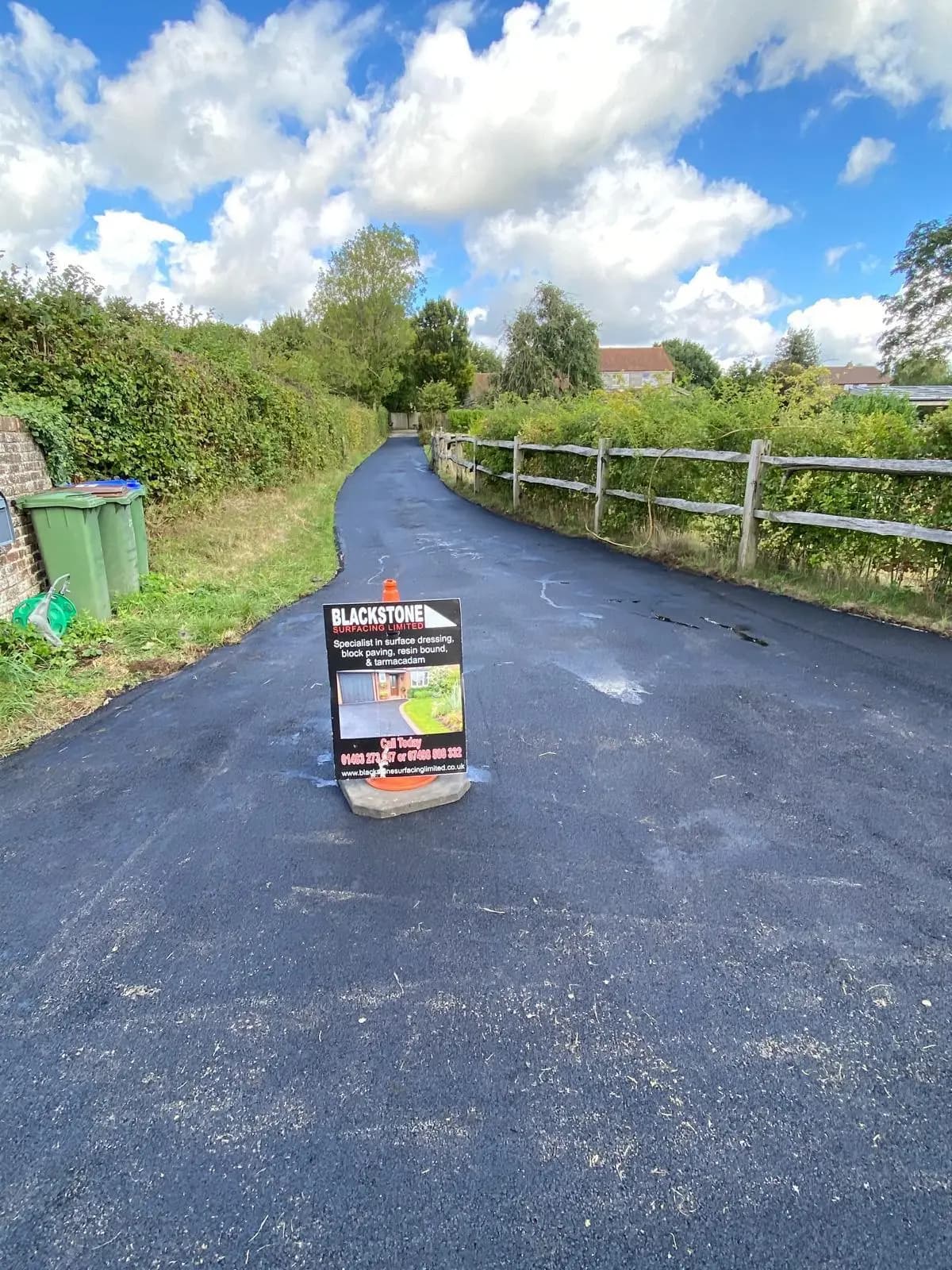
A smooth, durable tarmac lane that sheds water and rides cleanly end to end — no more potholes or standing water.
See the full projectWhat it is
Most unadopted roads in Surrey are carrying far more traffic than they were designed for, and the surface shows it. Where a highway authority would intervene on an adopted road, the responsibility falls to the landowner or management company — which means the decision about when to resurface, and to what standard, is a commercial one. Getting it right the first time matters, because a poorly specified overlay on a failing base just fails twice.
We carry out full-depth road surfacing and overlay schemes on private estates, industrial access roads, retail distribution yards, and unadopted residential roads. That covers everything from planing off the old surface and rebuilding the base to a single wearing-course overlay where the structure underneath is still sound. We work to NRSWA requirements where the carriageway adjoins or crosses public highway, and our gangs are experienced in managing live traffic and phasing works so access is never fully cut off.
The specification varies by use: a lightly loaded residential access road and a heavy-duty industrial haul route need different material grades and depths, and we size both accordingly. We will tell you honestly whether an overlay is appropriate for your road or whether the base needs attention first — because putting new tarmac over a failed structure is money wasted.
Best for
Recent work
A selection of finished road surfacing jobs — every one our own work.
How we work
We walk the road with you, assess the existing surface condition, check ironwork levels, and probe for areas of base failure. The quote includes a written specification — material grade, layer depths, and any drainage or ironwork we need to allow for. Nothing is left vague.
Where an overlay is appropriate, we plane off the existing surface to the required depth so levels are restored and the new course keys in properly. Where the base is failing, we cut out and rebuild those sections before any surface is laid. Ironwork — gullies, manhole covers, valve boxes — is re-set to the new finished level.
AC14 dense bitumen macadam binder course is laid and compacted to the design depth. On heavily trafficked routes or where the road takes delivery vehicles, the binder course is a structural layer in its own right, not an afterthought. Longitudinal and transverse joints are staggered so they don't coincide with the wearing course above.
AC10 or SMA wearing course is laid to the finished level and rolled to the correct density. Ironwork is checked flush once the surface has cooled. We sweep the road clear before opening to traffic and provide a brief written handover note on what to expect in the first weeks — minor scuffing from initial traffic is normal on new wearing course.
Materials & spec
An overlay is the lower-cost option and the right one when the base is structurally sound and the surface is worn but not deformed. Signs that an overlay is appropriate: the road is cracking at the surface but sitting flat, drainage is still functioning, and there is no significant rutting or fatigue cracking that suggests base failure.
The wrong call is laying a wearing course over a base that has already failed. Within a year or two, reflective cracking will reappear and the new surface will start to deform under load. If we see crocodile cracking, deep ruts, or soft spots when we walk the road, we will tell you — because the only honest answer at that point is targeted reconstruction before any surface is laid. The short-term saving on skipping base repairs is reliably smaller than the cost of doing the job again.
On a single-carriageway access road serving occupied properties or a working industrial unit, closing the entire road for a week is not usually acceptable. We phase road surfacing in half-carriageway passes or in sections, with traffic management in place, so that vehicles can get through throughout the works. This adds a small amount to the programme but is almost always the right approach.
For larger schemes on private estates, we agree a phasing plan with the client before mobilising. That plan covers which sections are live each day, where residents or delivery vehicles are diverted, and what the access arrangements are for emergency vehicles. NRSWA rules apply where works affect or adjoin public highway, and our operatives hold the relevant streetworks qualifications.
See also
Comparing options? Have a look at the other services we offer alongside road surfacing.
Commercial
Private estates, residents' associations, school grounds.
Commercial
New build and resurfacing, with line marking included.
Commercial
Cost-effective sealing of existing carriageways.
Commercial
Reactive and programmed pothole repair contracts.
FAQ
An adopted road is maintained at public expense by the highway authority — Surrey County Council in this area. An unadopted road is privately owned and maintained, which means the cost of resurfacing falls to whoever owns the road, usually a management company, a residents' association, or a private landowner. If you are not sure of your road's status, the highway authority's record of streets is publicly searchable, or we can advise based on the site.
A visual inspection will usually tell us. Surface cracking on its own points to an overlay solution. Rutting, fatigue cracking (the 'crocodile skin' pattern), soft spots underfoot, or standing water that hasn't been there historically all suggest base failure. We carry out a condition survey before quoting and will give you a straight answer — including an estimate of how many more years an overlay will buy you versus a full rebuild.
If the works are entirely within private land and do not affect the public highway or any services in the public highway, NRSWA does not strictly apply. However, where our works approach or cross a public carriageway — for example, where a private estate road meets a public junction — we manage the interface properly, with correctly qualified operatives and, where required, a Section 50 licence. We will tell you what applies on your site.
For regular HGV traffic the wearing course should be AC10 close-graded or SMA rather than the lighter grades used on residential drives. The binder course depth should be 70–80mm on a sound base, and where the base has been compromised we would rebuild to at least 225mm of compacted sub-base before laying asphalt. We size the specification to your actual traffic — there is no point building a motorway-grade road for a light estate access, and no point laying a thin overlay on a road that takes 40-tonne artics.
Yes. Re-setting ironwork to the new finished level is part of every road surfacing contract we carry out. Where covers or frames are damaged or no longer fit for purpose, we can supply and fit replacement units. We notify the relevant utility owners where required. Ironwork that is left proud of the new surface is both a liability and a tyre-wear issue, so we treat it as a standard line item, not an extra.
Tell us where you are and roughly what you'd like done. Free site visit, written quote, no pressure.
We also work in
Surfacing in
Period homes off the Hog's Back, new builds around the A3 corridor.
See work in Guildford→Surfacing in
From Hook Heath driveways to commercial yards near Sheerwater.
See work in Woking→Surfacing in
Stoke D'Abernon homes and the Fairmile estates.
See work in Cobham→Surfacing in
St George's Hill and Burwood Park resin and block paving.
See work in Weybridge→Surfacing in
Claygate, Hinchley Wood, and Esher village driveways.
See work in Esher→Surfacing in
Conservation areas and rural plots around the town.
See work in Farnham→