

Surfacing in
Guildford
Period homes off the Hog's Back, new builds around the A3 corridor.
See work in Guildford→We will beat ANY like for like quotation. Contact us for more information.
Residential service
Permeable resin-bound aggregates, smooth and SuDS-compliant.
 BeforeAfter
Before & after
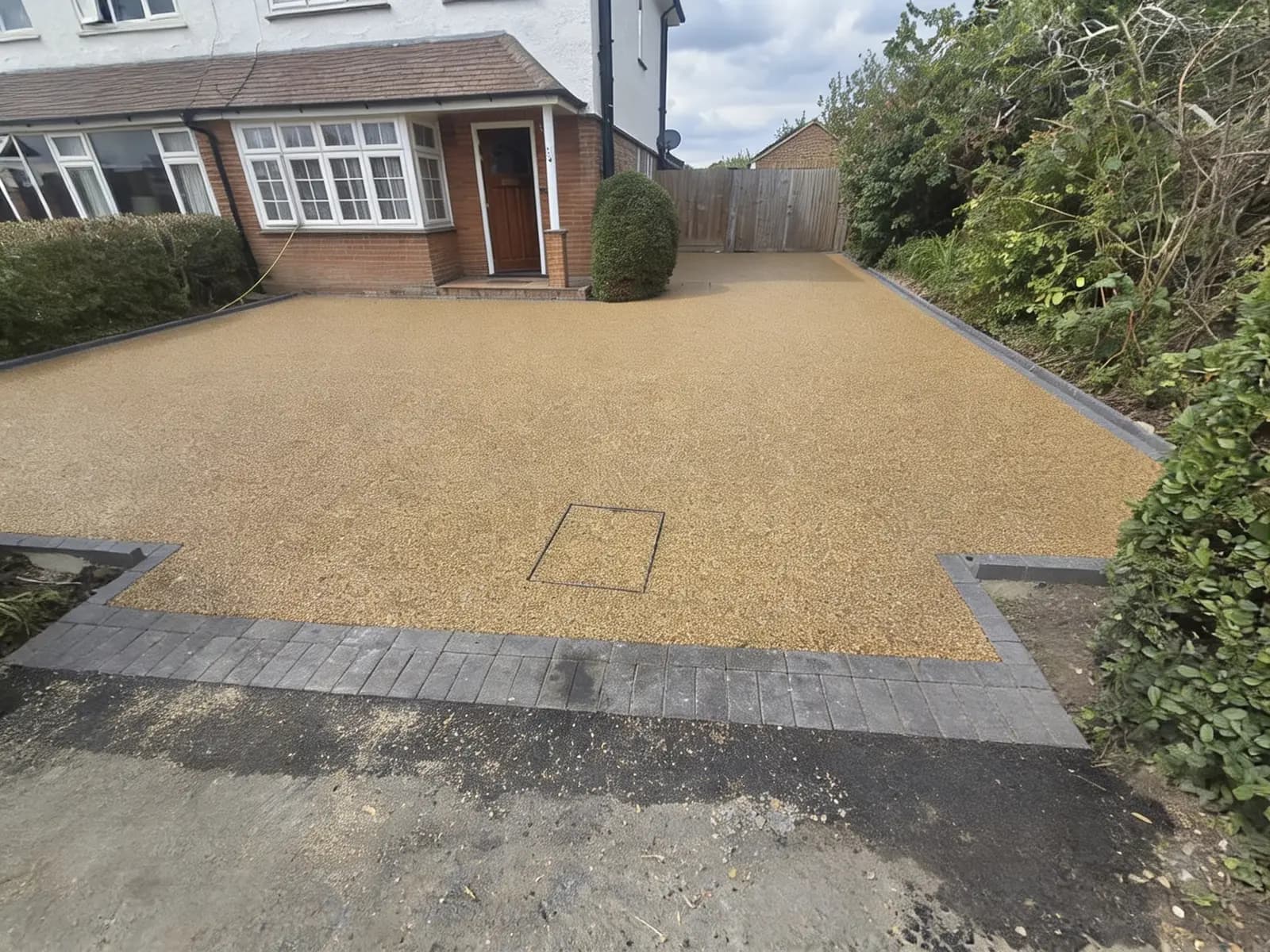
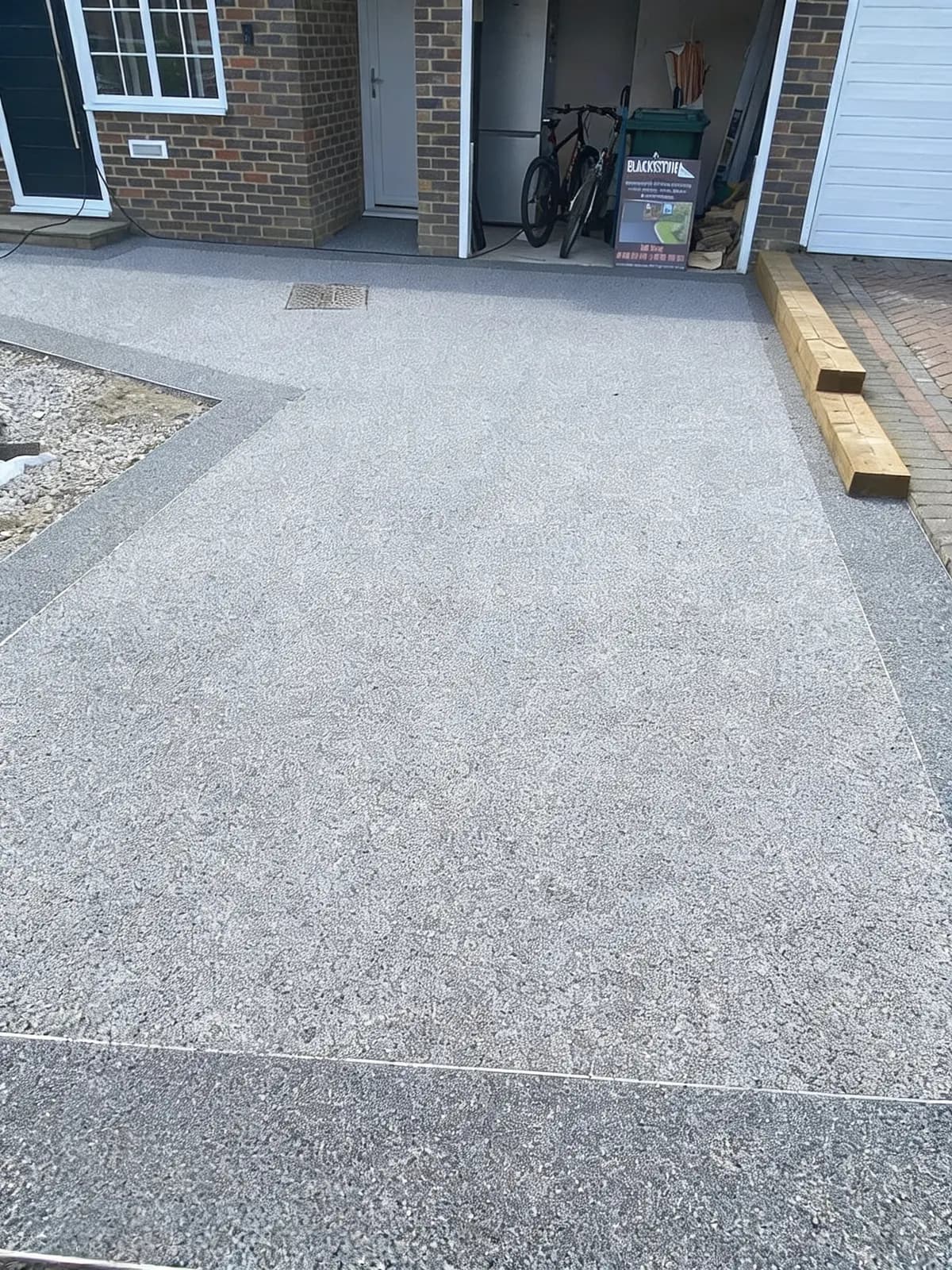
A smooth, low-maintenance silver-grey resin driveway laid over the sound existing base — seamless, hard-wearing, and a clear step up from the old concrete.
See the full projectWhat it is
Resin bound is the smoothest, most low-maintenance hard driveway you can install today — and on a well-built base it earns that reputation. The finish is a single seamless layer of natural aggregate locked in a two-part polyurethane resin, trowelled flat by hand. There are no joints to harbour weeds, no loose stones to track indoors, and because the aggregate itself is what you see, the colour doesn't fade the way a painted or coated surface would.
The permeable structure is what separates proper resin bound from every cheaper-looking alternative. Water moves through the surface and into the sub-base rather than sheeting off the edge. That makes a correctly installed resin driveway SuDS-compliant under the General Permitted Development Order without a separate soakaway — as long as the base beneath it is also open-graded and free-draining. A resin top on a closed tarmac sub-base drains nowhere, which is both a planning issue and a failure waiting to happen when the water gets in sideways.
We mix every batch on site in a forced-action mixer, not in a drum. Drum mixing doesn't coat the aggregate evenly and the result is patchy once it cures. We also only fit resin when the ground temperature and air humidity sit within the resin manufacturer's parameters — laying in cold or damp conditions is one of the most common reasons resin drives delaminate within a couple of years.
Best for
Recent work
A selection of finished resin jobs — every one our own work.
Resin driveway · Crawley, West Sussex
Resin driveway & artificial lawn · Croydon
Resin driveway · Worcester Park
Resin driveway · Cobham
Resin driveway · Farnham, Surrey
Resin driveway · Horsham, West Sussex
How we work
Resin is only as good as what it sticks to. We inspect the existing surface — or build a new open-graded macadam or porous concrete base from scratch — and confirm it is structurally sound, fully permeable, and free of standing water. Soft spots and edge failures are remedied before any resin is ordered.
You choose from a range of washed natural aggregates — typically 1–3mm or 2–5mm rounded stone — which we order dry and dust-free. On the day of installation, aggregate and resin are combined in the correct ratio in a forced-action mixer and the batch is used within the working time window, usually 20–25 minutes.
The mixed resin slurry is tipped onto the base and spread to an even depth — typically 15–18mm — using steel trowels. Our crew work in bays, keeping wet edges live so the finish is seamless across the whole area. Manholes and gully tops are masked and edged carefully to keep lines clean.
Resin bound cures fully in approximately 24 hours at normal temperatures, though foot traffic is often possible within a few hours. We check the surface for any pinholes or low spots, apply edge sealant where required, and walk the job with you before we leave. Light vehicle traffic is safe at 24 hours; we advise waiting 48–72 hours for heavy or regular parking.
Materials & spec
The terminology trips people up at the quote stage. Resin bound means aggregate and resin are mixed together and trowelled flat — the finish is smooth, permeable, and durable. Resin bonded means a coat of resin is painted onto the existing surface and loose chippings are scattered and pressed in. It costs less to lay, it is not permeable, the chippings shed within a few years, and it looks worn quickly. If a quote uses the word 'bonded,' ask exactly which process is being priced.
A lower price for resin work almost always means one of three things: aromatic rather than UV-stable resin that will yellow; a thinner depth than 15mm; or a non-permeable base with no drainage solution. None of these failures are immediately obvious — they show up 18 months to three years in.
A well-installed resin bound surface on a sound base is genuinely low maintenance. It does not need sealing, it does not grow weeds through the surface, and it does not lose aggregate if the resin is properly cured. Occasional sweeping and a rinse with a domestic pressure washer on a low setting is all it needs.
The common long-term issue is edge creep if the metal edging was not bedded firmly, and localised delamination if the base was damp or the resin was mixed in cold conditions. Both are installation failures rather than material failures. Repairs are possible — a damaged section can be cut out and relaid — but the patch, unlike block paving, is visible on close inspection. Picking a contractor who gets the installation right is more important with resin than with almost any other surface.
See also
Comparing options? Have a look at the other services we offer alongside resin.
Residential
Marshalls and Bradstone block paving installed to BS 7533.
Residential
Hot-laid tarmacadam for long, hard-wearing driveways.
Residential
Bound or loose gravel with stable sub-base and edging.
Residential
Porcelain, sandstone, and block paving patios and paths.
FAQ
On a correctly prepared base, a resin bound surface typically performs well for 15–25 years. The limiting factors are UV exposure over decades (UV-stable aliphatic resins hold colour far longer than aromatic alternatives), and the condition of the base underneath. A resin surface installed over a failing sub-base will fail regardless of the resin quality.
A permeable resin bound surface on a permeable base is inherently frost-resistant because water drains through rather than sitting in it. Freeze-thaw damage happens when water is trapped beneath a surface — which is exactly what an open-graded base prevents. That said, if the sub-base becomes saturated due to poor construction, frost can cause lifting, just as with any other surface.
Sometimes, yes — but only if the existing surface is structurally sound, firmly bonded to the base beneath it, and free of cracks or soft spots. Resin applied over a deteriorating surface will replicate every movement in what's underneath. We always assess the existing base before agreeing to an overlay and will tell you honestly if a full preparation is needed.
No. The rounded aggregate gives a slip-resistant texture when wet — it performs better than polished tarmac or concrete under foot. It is suitable for pedestrian areas, sloped driveways, and access ramps as long as the falls are designed correctly.
Yellowing is almost always caused by aromatic polyurethane resin, which is cheaper to buy and degrades in UV light. UV-stable aliphatic resin doesn't yellow. Patchiness can result from uneven mixing — drum-mixed batches coat the aggregate inconsistently — or from laying in damp or cold conditions that prevent a proper cure. We use UV-stable resin and forced-action mixing on every job.
Tell us where you are and roughly what you'd like done. Free site visit, written quote, no pressure.
We also work in
Surfacing in
Period homes off the Hog's Back, new builds around the A3 corridor.
See work in Guildford→Surfacing in
From Hook Heath driveways to commercial yards near Sheerwater.
See work in Woking→Surfacing in
Stoke D'Abernon homes and the Fairmile estates.
See work in Cobham→Surfacing in
St George's Hill and Burwood Park resin and block paving.
See work in Weybridge→Surfacing in
Claygate, Hinchley Wood, and Esher village driveways.
See work in Esher→Surfacing in
Conservation areas and rural plots around the town.
See work in Farnham→