

Surfacing in
Guildford
Period homes off the Hog's Back, new builds around the A3 corridor.
See work in Guildford→We will beat ANY like for like quotation. Contact us for more information.
Commercial service
Reactive and programmed pothole repair contracts.
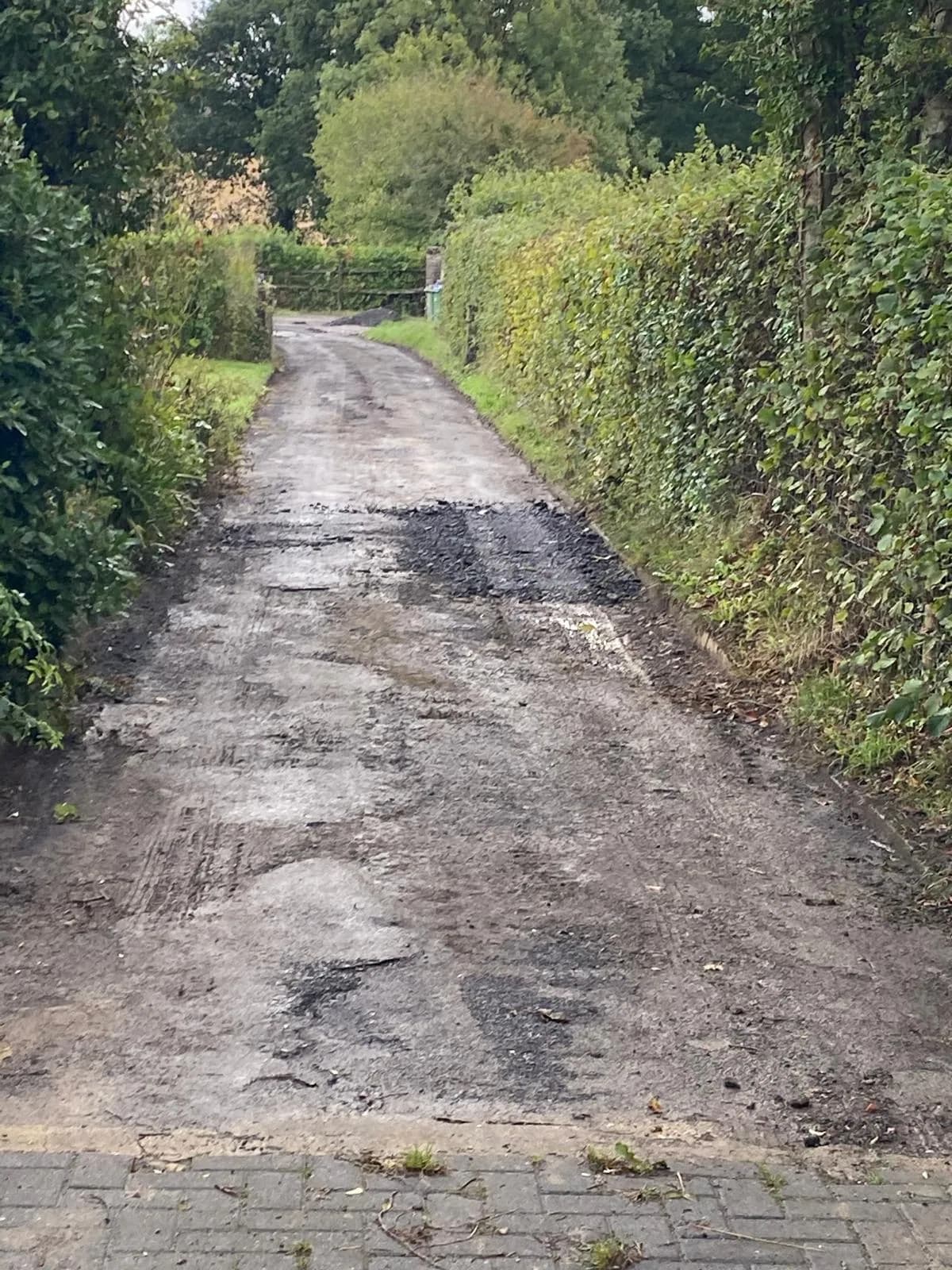
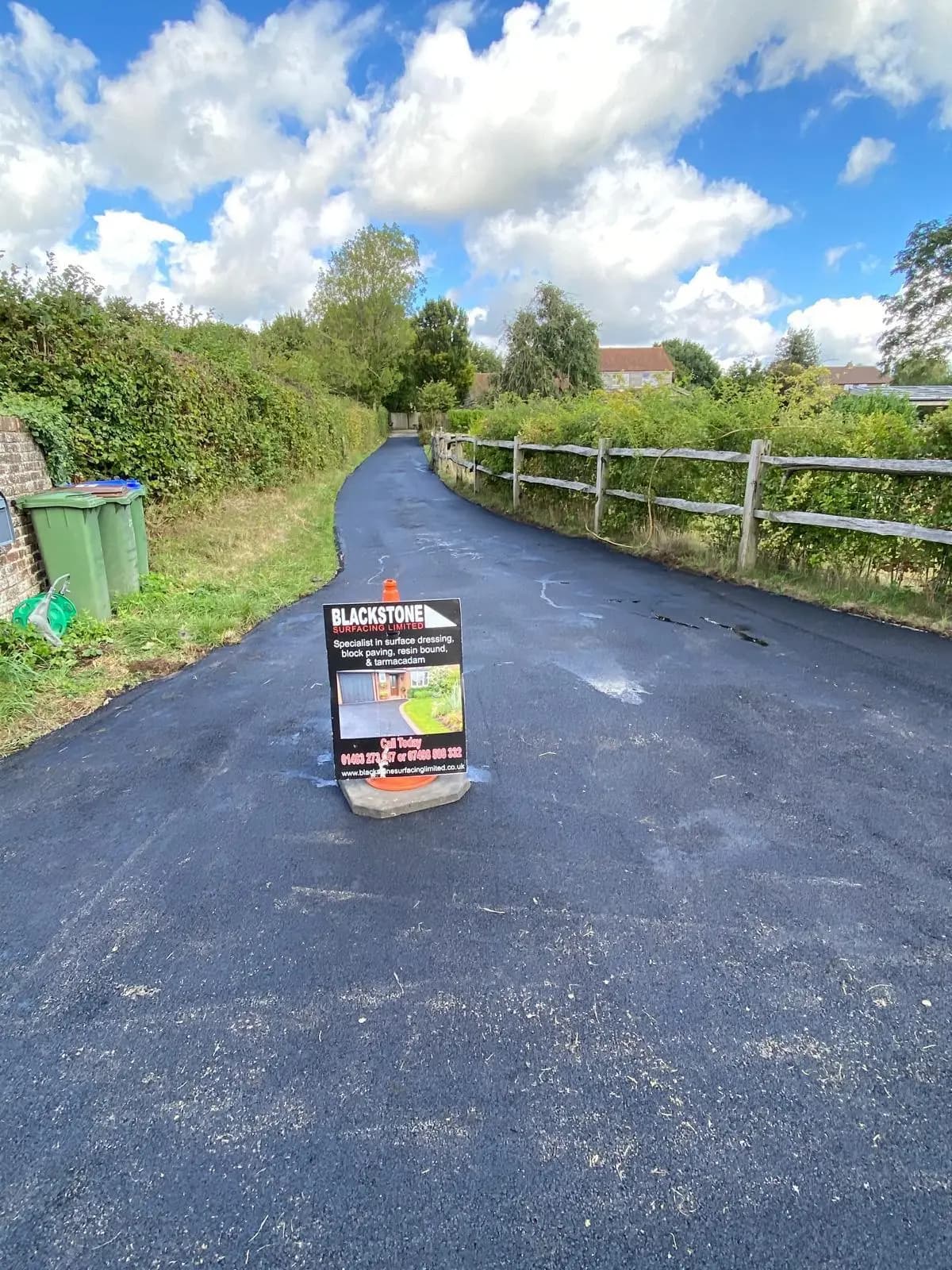 BeforeAfter
Before & after
A smooth, durable tarmac lane that sheds water and rides cleanly end to end — no more potholes or standing water.
See the full projectWhat it is
Potholes form when water infiltrates a weakened surface, saturates the base course, and then freezes or is driven out under load. The hole you can see is almost always the tip of a larger area of delamination or base failure working outward from it. Filling the visible void without addressing the surrounding surface just postpones the same repair — which is why we cut back to sound material on every job, no matter how small the hole looks at first.
For property managers and estate companies, the practical question is rarely whether to fix a pothole but when, and in what order. A reactive programme — responding to individual defects as they are reported — keeps the most dangerous holes filled quickly. A programmed inspection round visits the same roads on a fixed cycle, catches defects earlier when they are cheaper to repair, and builds the photographic record that constitutes a credible inspection-and-repair defence if a claim arises.
We run both. Single call-outs are available for urgent defects. Standing repair contracts for estates, private roads, and commercial car parks cover agreed roads on a scheduled cycle, with a documented condition log after every round. Both services cover Surrey and the surrounding area.
Best for
How we work
We saw-cut the pothole to a square or rectangular outline, cutting back beyond the visibly damaged area until the cut edges sit on sound material. The loose and contaminated material is removed entirely, leaving a clean vertical face on all four sides and a firm, dry base. Cutting to shape rather than filling the ragged void is the single step that separates a repair that lasts from one that fails at the edges inside a season.
The cleaned void is primed with a bitumen tack coat applied to the base and all four faces. The tack coat bonds the new fill to the surrounding carriageway and prevents water tracking between the old and new material. It is allowed to become tacky before filling commences — application straight into a wet prime is a common shortcut that undermines bond strength.
The void is filled with hot-laid AC10 close-graded asphalt, placed in lifts no deeper than 75mm to ensure full compaction throughout the depth. For deeper voids, a binder course layer of AC14 is laid first, followed by the AC10 wearing course, matching the road's original construction. Each layer is compacted by plate or roller until the repaired surface is proud by 2–3mm to allow for final traffic settlement.
Every repair is photographed before work begins and after completion — showing the defect, its dimensions, the clean-cut void, and the finished surface. These records are kept for a minimum of three years and handed to the client as part of the repair log. On programmed contracts, each visit generates a condition report covering all roads inspected, including any new defects noted but deferred for the next round, with a recommended action and timescale.
Materials & spec
In the event of a vehicle damage or personal injury claim arising from a road defect, the established defence for highway and estate managers is demonstrating a reasonable system of inspection and repair. That requires two things: evidence that defects are identified promptly, and evidence that they are fixed within a reasonable timescale once identified. A photographic repair log — timestamped, showing the defect before and after — is the simplest way to demonstrate both.
Unrepaired potholes are a liability that compounds over time. Courts and insurers take a dim view of defects that appear on earlier inspection records and were not acted upon. A programmed contract with documented rounds creates a clear, defensible paper trail. A reactive-only approach, where repairs happen only after complaints arrive, rarely satisfies the reasonable-system test, because complaint-driven repairs will always lag behind new defects.
We provide a repair record after every job and a full condition report after every programmed inspection round. These documents are designed to be retained alongside your existing inspection records and are formatted to be useful in a claim situation — not just proof of payment.
Reactive repair — responding to individual defects as they are reported — is the right model when a road is generally in good condition and defects are infrequent. It is cost-effective precisely because it does nothing when nothing needs doing. The risk is that defects between inspection points are missed or grow large before they are reported.
Programmed repair rounds visit roads on a fixed cycle — commonly every one to three months depending on traffic and condition — and catch defects at their smallest and cheapest. Over a five-year period, the total cost of a programmed contract is almost always lower than reactive-only, because repairs happen at the £100–£200 stage rather than the £400–£1,500 stage. The additional benefit is the inspection record, which no purely reactive model can provide.
For most private roads and managed estates, a hybrid model works best: a programmed quarterly round supplemented by a 48-hour reactive call-out service for any urgent defects reported between rounds. We offer both as part of a standing maintenance agreement.
See also
Comparing options? Have a look at the other services we offer alongside potholes.
Commercial
New build and resurfacing, with line marking included.
Commercial
Cost-effective sealing of existing carriageways.
Commercial
Adopted and unadopted roads, NRSWA-compliant.
Commercial
Private estates, residents' associations, school grounds.
FAQ
For one-off reactive jobs, we price by the individual repair, typically based on the cut-out area and depth. For programmed contracts covering multiple roads, we usually agree a day rate or a schedule-of-rates contract where each repair type (small, medium, deep) has a fixed unit price. The schedule-of-rates approach gives budget predictability without paying for a fixed number of repairs whether they are needed or not. We will recommend the right model at the survey stage.
Hot-lay asphalt can be placed in light rain, but the base of the void must be dry before the tack coat is applied — a wet base prevents the bitumen bonding correctly. For urgent repairs in persistent wet weather we can place a cold-lay temporary repair to make the defect safe, then return for the permanent hot-lay repair once conditions allow. We will always confirm what type of repair is being placed and why.
Hot-fill uses asphalt mixed and delivered at approximately 150°C and compacted while hot. It bonds fully to the surrounding road, compacts to a dense, durable finish, and is the correct permanent repair for any carriageway defect. Cold-fill uses a pre-mixed bituminous compound applied at ambient temperature. It is faster to mobilise and useful for making a dangerous defect temporarily safe, but it degrades faster under traffic and should not be considered a permanent solution.
Yes. The majority of our pothole repair work is on private roads, managed estate roads, industrial access roads, and commercial car parks — all of which sit outside the highway authority's maintenance responsibility. We are familiar with the particular considerations of private road management, including access coordination with residents or tenants and the need for client-facing repair records rather than highway authority ones.
A correctly executed hot-lay repair — saw-cut, cleaned, primed, filled with AC10, and compacted — should last at least five years in normal traffic conditions. In practice, the surrounding carriageway usually develops new defects before the repair itself fails, which is why programmed maintenance rather than one-off patching produces better long-term value. The single biggest cause of early repair failure is insufficient preparation: filling rather than cutting, or applying material into a damp or contaminated void.
Tell us where you are and roughly what you'd like done. Free site visit, written quote, no pressure.
We also work in
Surfacing in
Period homes off the Hog's Back, new builds around the A3 corridor.
See work in Guildford→Surfacing in
From Hook Heath driveways to commercial yards near Sheerwater.
See work in Woking→Surfacing in
Stoke D'Abernon homes and the Fairmile estates.
See work in Cobham→Surfacing in
St George's Hill and Burwood Park resin and block paving.
See work in Weybridge→Surfacing in
Claygate, Hinchley Wood, and Esher village driveways.
See work in Esher→Surfacing in
Conservation areas and rural plots around the town.
See work in Farnham→