

Surfacing in
Guildford
Period homes off the Hog's Back, new builds around the A3 corridor.
See work in Guildford→We will beat ANY like for like quotation. Contact us for more information.
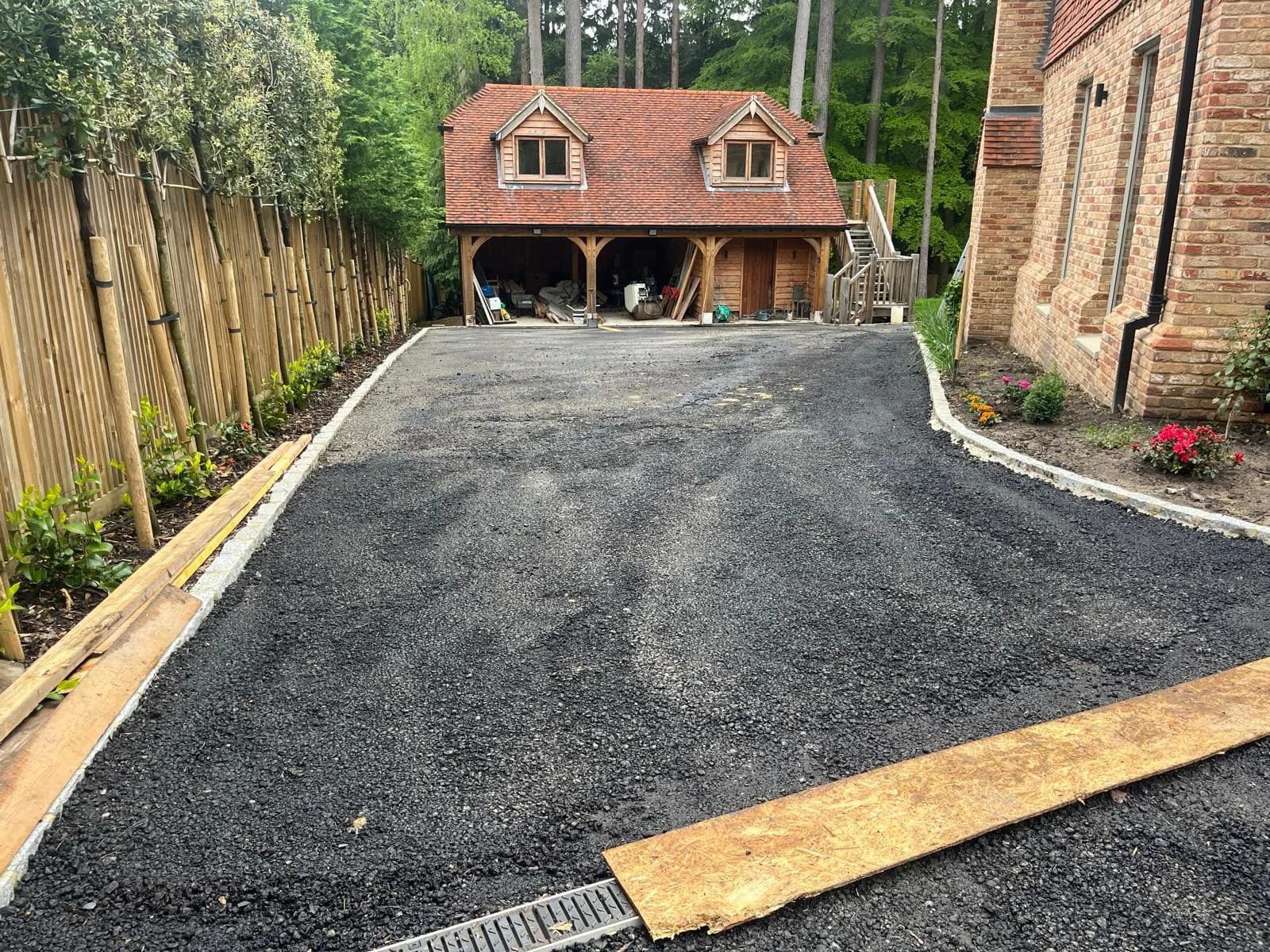
Commercial service
New build and resurfacing, with line marking included.
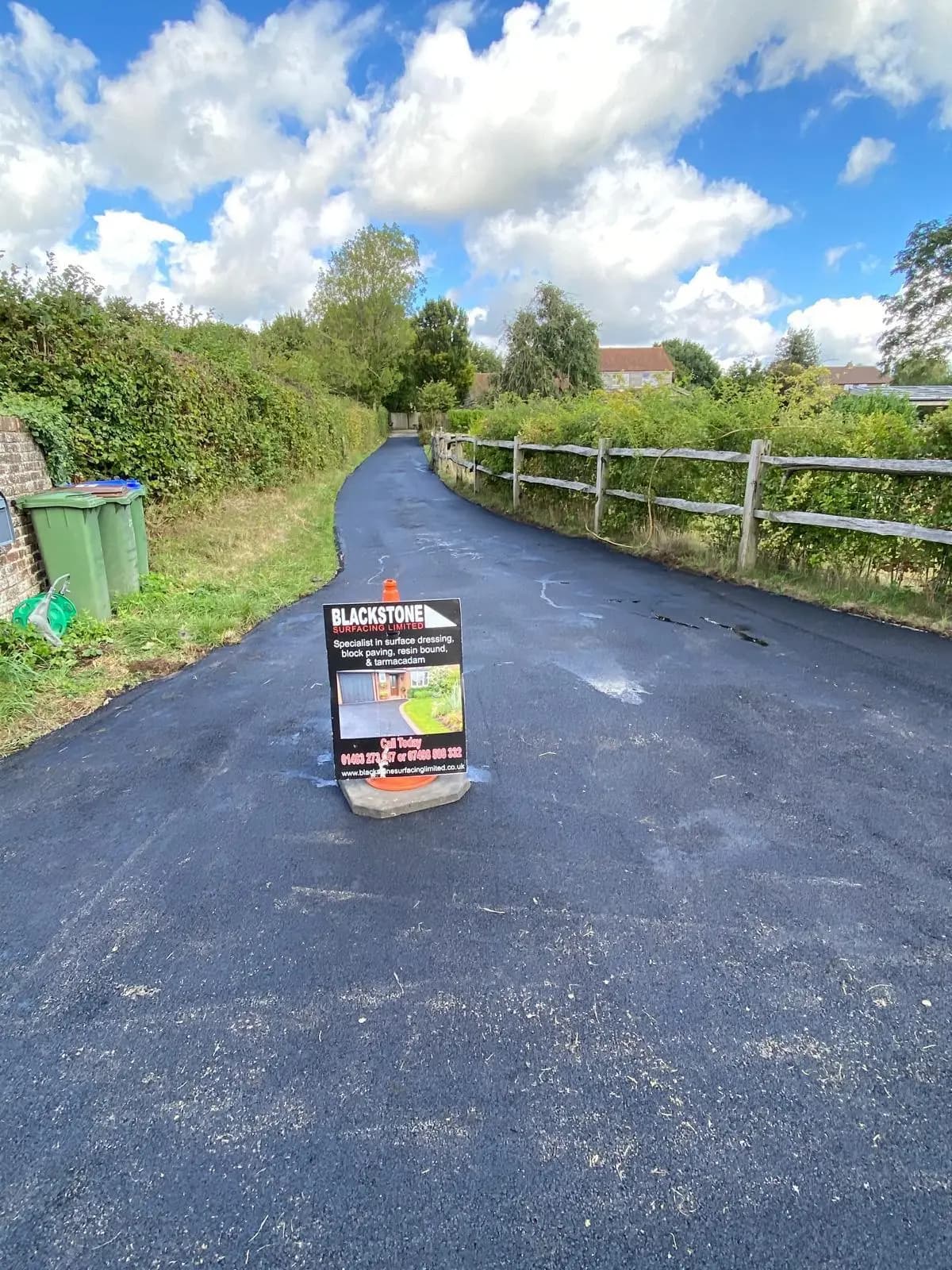 BeforeAfter
Before & after
A smooth, durable tarmac lane that sheds water and rides cleanly end to end — no more potholes or standing water.
See the full projectWhat it is
A car park surface does a job that most people only notice when it fails — potholes that trip pedestrians, standing water that pools outside the entrance, faded line markings that cause disputes over bays. For a property manager or facilities team, the car park is also a liability surface, and the standard defence against claims is a demonstrable programme of inspection and maintenance. That starts with getting the surface built or rebuilt correctly.
We carry out car park surfacing from new build through to full resurfacing of existing sites, and we include line marking and drainage in the same contract rather than passing that coordination to someone else. The work covers retail parks, office campus car parks, trade-counter yards, residential developments, and multi-storey deck overlays — anywhere the surface takes regular vehicle circulation and pedestrian movement across the same area.
The specification for a car park differs from a road in one important respect: the loading pattern is stop-start rather than rolling, and that puts different stress on the wearing course. We use materials and depths appropriate to car park use, including SMA or polymer-modified binders where the site takes sustained queuing or heavy deliveries, and we design the surface falls so that water clears through the drainage system rather than sitting in low spots between bays.
Best for
How we work
We survey the existing surface, check drainage outlets and falls, and assess whether the base is structurally sound or requires reconstruction in sections. For occupied sites we prepare a phasing plan before quoting — showing which bays or sections are closed each day and how the rest of the car park stays usable. For new builds we review the drainage design and agree finished levels with the groundworks team.
Existing surfaces are planed to the required depth. Failed base sections are cut out and rebuilt with compacted Type 1 sub-base and new binder course, rather than patched over. Drainage gullies, kerb channels, and any ironwork are re-set to the new level. Where the base is sound, tack coat is applied to the planed surface to bond the new wearing course.
AC10 close-graded wearing course is laid at 25–30mm and compacted with a roller to achieve the right surface density. On sites with sustained heavy vehicle movement — delivery bays, refuse collection points — we specify SMA or a polymer-modified mix for greater resistance to deformation under stationary loads. Falls are checked against the drainage design as laying progresses so corrections can be made before the material cools.
Thermoplastic line marking is applied once the surface has fully cooled and cured — typically the following day. Bays, directional arrows, accessible parking spaces (to BS 8300 dimensions), hatching, and give-way markings are all set out from a survey drawing agreed with the client beforehand. We photograph the finished layout before handover so there is a record of bay dimensions and accessible-space locations.
Materials & spec
Most occupied car parks cannot simply be closed for a week. We phase the work in sections — typically half or a quarter of the total bays at a time — so that a usable portion of the car park remains open throughout. The phasing plan is agreed with the client before we mobilise and includes how temporary access and pedestrian routes are managed. On retail sites we usually programme the noisiest and dustiest work for early morning before trading starts.
The trade-off with phasing is programme length. A car park done in three phases takes longer than the same car park done in one. We will give you both options and let you decide — some clients prefer a single week of full closure during a quiet period, and where that is feasible it is often the cleaner solution.
A car park surface in fair condition with isolated potholes and faded line marking is a candidate for programmed patching plus a line-marking refresh — that is a significantly lower outlay than a full resurface. A surface with widespread fatigue cracking, drainage problems, or areas where the base has failed is not, and patching it buys a year or two at most before the same problems return at greater scale.
When we survey a site, we will give you our honest assessment of which category it falls into. We can also sequence works if budget is a constraint — address the worst sections and the drainage in year one, overlay the remainder in year two or three. That approach costs more in total than doing it all at once but spreads the spend and keeps the car park functional throughout.
See also
Comparing options? Have a look at the other services we offer alongside car parks.
Commercial
Thermoplastic and paint line marking, accessible bays, hatching.
Commercial
Adopted and unadopted roads, NRSWA-compliant.
Commercial
Reactive and programmed pothole repair contracts.
Commercial
Cost-effective sealing of existing carriageways.
FAQ
A mid-sized car park of 50–100 bays typically takes three to five days of surfacing work, plus a further day for line marking once the surface has cured. Phased works on an occupied site add to the overall programme. We will give you a day-by-day schedule with the written quote so you can communicate it to staff or tenants in advance.
Line marking is included within our car park surfacing contracts as standard. We set out bays, accessible spaces, arrows, and any hatching from a drawing agreed with you beforehand, and we apply thermoplastic rather than paint — it bonds to the new surface and lasts considerably longer. The only thing we ask for in advance is confirmation of the number of standard and accessible bays, and any specific layout requirements.
Thermoplastic is a solid material that is heated and applied to the surface, where it fuses as it cools. It is harder-wearing, more reflective, and better bonded than road-marking paint. On a high-circulation car park, paint can start to wear within 18 months; thermoplastic typically lasts five years or more under the same conditions. We use thermoplastic as our default for all new surfacing work — paint is only specified when the client has a specific reason for it.
The number of accessible spaces is set by planning conditions for new builds, and by Approved Document M and BS 8300 guidance for existing sites. As a practical rule, BS 8300 recommends one accessible space per 20 standard spaces for non-residential car parks. The standard accessible bay dimension is 2.4m wide with a 1.2m adjacent access strip, giving an overall 3.6m width — we set these out correctly as a matter of course, as non-compliant dimensions create both practical and liability issues.
Often, yes. Many drainage problems in car parks are caused by falls that have changed as the surface has deformed over time, rather than by failed drainage infrastructure. Laying the new surface to the correct falls, re-setting gully tops, and clearing any blocked outlets is frequently enough to restore drainage function. Where the pipework itself is blocked or collapsed, we can scope that as part of the pre-works survey and build it into the contract — it is far better to sort it before laying a new surface than to discover it afterwards.
Tell us where you are and roughly what you'd like done. Free site visit, written quote, no pressure.
We also work in
Surfacing in
Period homes off the Hog's Back, new builds around the A3 corridor.
See work in Guildford→Surfacing in
From Hook Heath driveways to commercial yards near Sheerwater.
See work in Woking→Surfacing in
Stoke D'Abernon homes and the Fairmile estates.
See work in Cobham→Surfacing in
St George's Hill and Burwood Park resin and block paving.
See work in Weybridge→Surfacing in
Claygate, Hinchley Wood, and Esher village driveways.
See work in Esher→Surfacing in
Conservation areas and rural plots around the town.
See work in Farnham→