

Surfacing in
Guildford
Period homes off the Hog's Back, new builds around the A3 corridor.
See work in Guildford→We will beat ANY like for like quotation. Contact us for more information.
Residential service
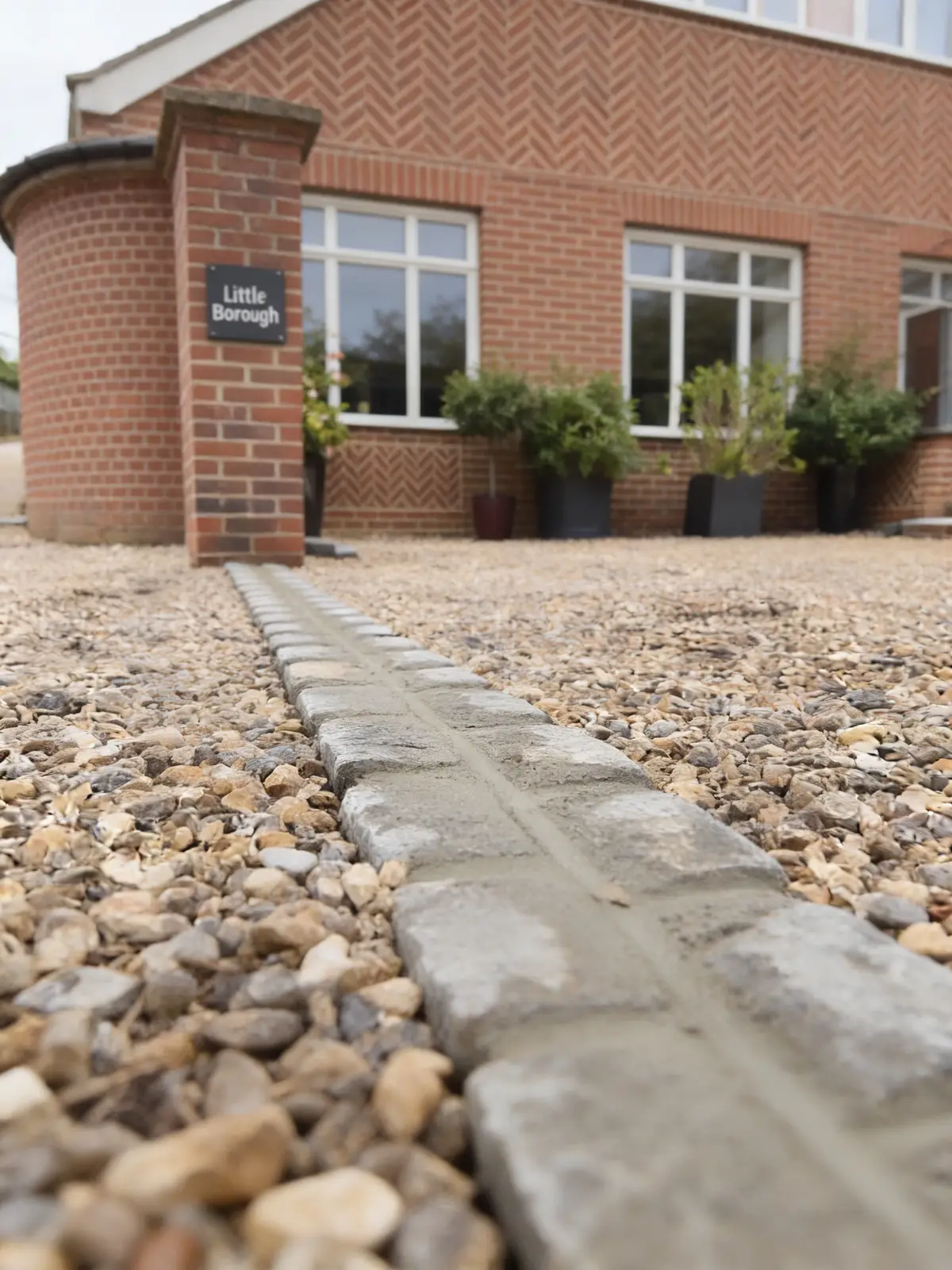
Bound or loose gravel with stable sub-base and edging.
 BeforeAfter
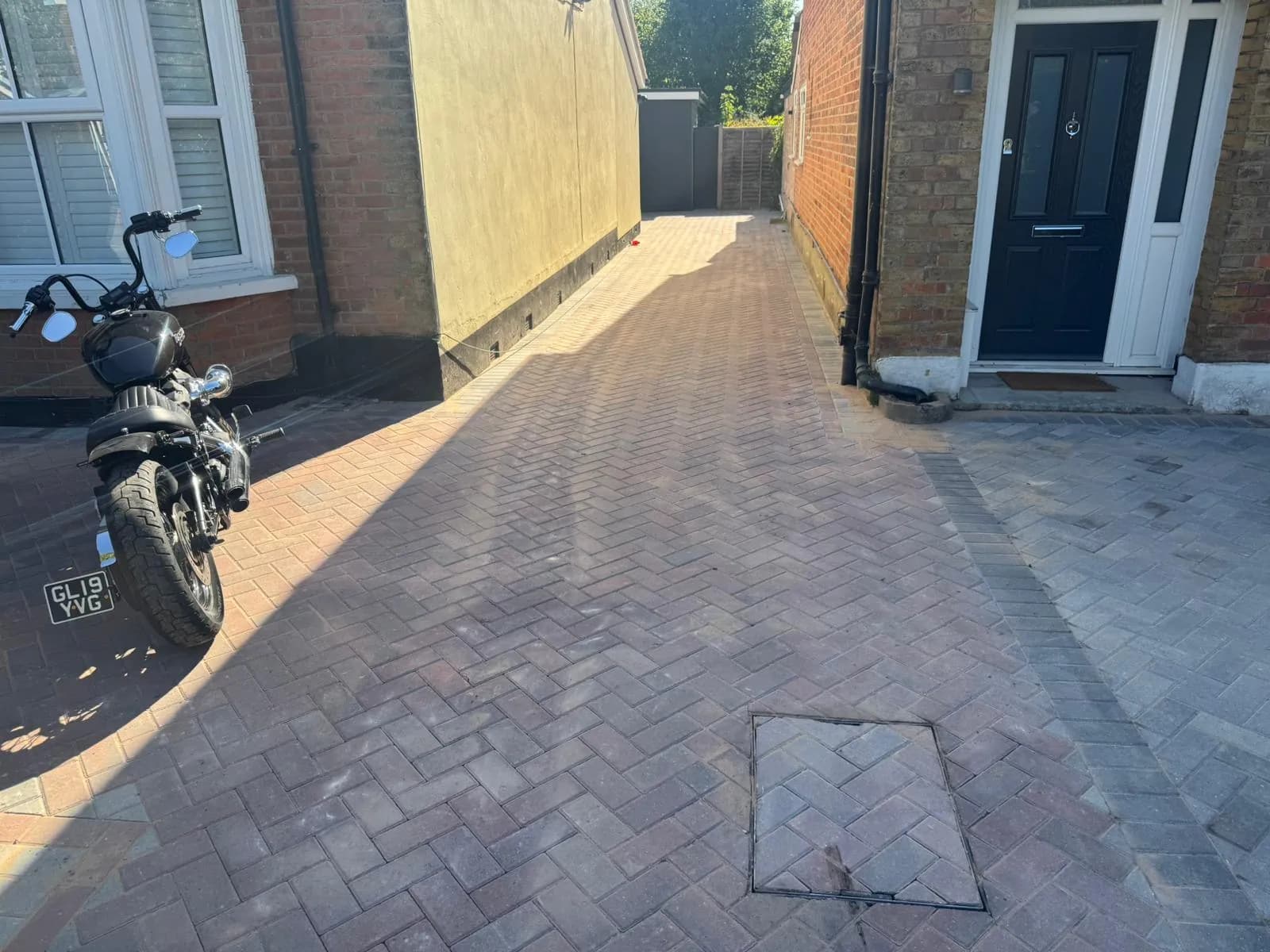
Before & after
A clean brindle block paved courtyard and side access that ties the front and rear together — hard-wearing, weed-free and a clear lift from the worn gravel it replaced.
See the full projectWhat it is
Gravel is the oldest hard-standing surface going, and the reason it is still specified on period houses, rural plots, and large country frontages is that nothing else quite matches it for character. The colour and texture are natural — actual stone, not a coating — and the visual weight of a loose stone surface suits a Georgian or Victorian property in a way that a seamless resin or uniform block drive often doesn't.
The problems most people associate with gravel — stones scattered across the lawn, loose surface on a slope, wheel ruts, and constant topping-up — are almost entirely installation failures rather than material ones. They come from laying stone directly onto bare ground with no base preparation, no proper edging, and no consideration for the depth of stone needed to stay stable under tyres. A well-built gravel drive has a compacted sub-base, a containment system at every edge, and enough depth of clean angular stone that it locks together under traffic rather than spreading.
We offer both loose gravel on a compacted sub-base for a traditional finish, and resin-bonded gravel for slopes or areas where stone migration really cannot happen. The two are different products with different costs and different maintenance profiles, and we'll walk you through both at the site visit if the question is open.
Best for
How we work
We strip and excavate to the depth required — typically 100–150mm for the sub-base plus the gravel layer above it. The formation level is checked for soft spots or clay that will pump under load; any soft areas are dug out further and replaced with compacted granular fill. Falls are set from the outset so that water drains away from the house and to an appropriate outlet.
A layer of Type 1 MOT crushed stone is spread and compacted with a vibrating plate in two passes. This is the layer most often skipped on cheap gravel jobs — and its absence is why the surface ruts, sinks unevenly, and throws stones sideways under braking. The sub-base gives the gravel a stable platform to sit on rather than working into soft ground over time.
Before any gravel goes down, all edges are set: treated timber, concrete kerb, steel landscape edging, or brick soldier course depending on the property and aesthetic. Edging is the primary thing that keeps stone in the drive and off the lawn, and it needs to be set at the correct height — just above the finished gravel level — to act as a physical barrier under normal use.
Clean angular or rounded decorative stone is spread to a depth of 50–75mm — shallow enough to walk on easily, deep enough to give the surface stability under tyres. We rake to a level finish and tamp lightly. We advise on the aggregate most suited to the colour of the house and the practicality of the site — angular stone locks better; rounded pea gravel looks softer but migrates more.
Materials & spec
Loose gravel on a solid base is the most economical and visually natural option, but it does require the drive to be reasonably flat and have well-maintained edges to stay tidy. It is the right choice for most country and period residential driveways where a slight migration of stone is acceptable and the maintenance expectation is occasional raking rather than zero intervention.
Resin-bonded gravel — where a layer of two-part resin is applied to a bound surface and the chippings are then scattered and pressed in — is better suited to slopes, pathways, and areas where stone scatter is unacceptable. It is not the same as resin bound (the aggregate is not mixed through the resin) and is not permeable, so drainage must be designed into the base. It costs more and does not have the same longevity as a full resin bound surface. We are upfront about this distinction at the quote stage rather than conflating the two.
The most frequently asked question about gravel is whether it needs a lot of looking after. With a properly built base and good edging, the honest answer is: occasional raking to level out tyre ruts, an annual check on the edging, and a top-up of stone every few years as some inevitably migrates. That is materially less effort than re-jointing block paving or dealing with cracked tarmac.
The shortcuts that cause the most complaints are: no sub-base (the stone disappears into soft ground within a season); too shallow a depth (the membrane shows through in wheel tracks); no edging or edging set too low (stone crosses onto the lawn with every car movement). We will not quote a gravel drive without all three elements — they are what makes the job last.
See also
Comparing options? Have a look at the other services we offer alongside gravel.
Residential
Permeable resin-bound aggregates, smooth and SuDS-compliant.
Residential
Marshalls and Bradstone block paving installed to BS 7533.
Residential
Porcelain, sandstone, and block paving patios and paths.
Residential
Patching, re-jointing, re-sanding, and section replacement.
FAQ
Yes. Loose gravel on a permeable sub-base is one of the materials specifically cited as SuDS-compliant under the General Permitted Development Order 2008 amendment. Water passes through the stone and membrane and into the ground below, so there is no surface runoff to manage and no soakaway required. This is one of gravel's genuine advantages over tarmac and traditional block paving for new or replacement driveways over 5 square metres.
Some migration is inevitable with loose gravel, particularly on the approach to the garage and around foot-traffic areas near the front door. The practical solutions are: setting the edging and threshold slightly higher than the gravel level to act as a lip; using a coarser angular aggregate (20mm) near thresholds, which is harder to kick than smaller rounded stone; and placing a good door mat. A gravel grid system in high-traffic zones also reduces migration significantly. It will never be zero, but a well-built drive managed with the right aggregate is not a nuisance in practice.
On a properly built base with good edging, most driveways need a top-up every three to five years rather than annually. The rate depends on how much foot and vehicle traffic the drive sees, whether there are tight turning areas (which dislodge more stone than straight parking), and how much inevitably migrates to edges over time. When you do top up, match the stone type and size — mixing aggregates looks untidy and can affect drainage.
A gentle slope — up to around 1:10 — is manageable with angular stone and a stabilisation grid on top of the sub-base. The grid locks individual stones in place and prevents creep under braking and steering. Steeper gradients are generally better served by a bound surface such as tarmac or resin, where there is no loose material to move. We will advise on the threshold at the site visit based on the actual gradient.
There is no single answer, but the most common choices in Surrey are golden gravel (a warm buff-yellow rounded flint), natural buff limestone chippings, and grey granite setts. The general rule is to look at the house brickwork and point colour and choose a stone that complements rather than contrasts. We bring samples to the site visit so you can hold them against the property in natural light rather than choosing from a photograph.
Tell us where you are and roughly what you'd like done. Free site visit, written quote, no pressure.
We also work in
Surfacing in
Period homes off the Hog's Back, new builds around the A3 corridor.
See work in Guildford→Surfacing in
From Hook Heath driveways to commercial yards near Sheerwater.
See work in Woking→Surfacing in
Stoke D'Abernon homes and the Fairmile estates.
See work in Cobham→Surfacing in
St George's Hill and Burwood Park resin and block paving.
See work in Weybridge→Surfacing in
Claygate, Hinchley Wood, and Esher village driveways.
See work in Esher→Surfacing in
Conservation areas and rural plots around the town.
See work in Farnham→