

Surfacing in
Guildford
Period homes off the Hog's Back, new builds around the A3 corridor.
See work in Guildford→We will beat ANY like for like quotation. Contact us for more information.
Residential service
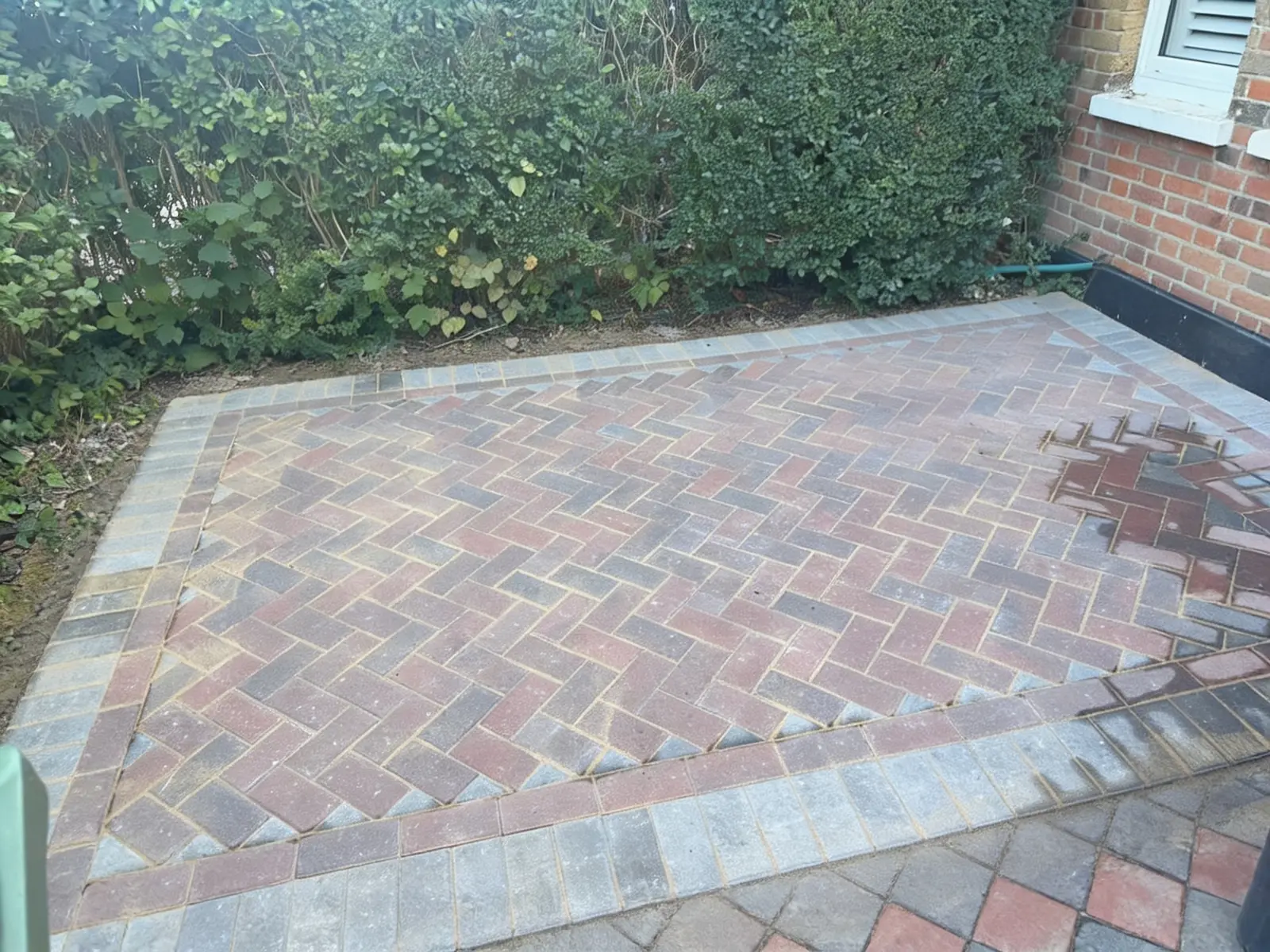
Porcelain, sandstone, and block paving patios and paths.
 BeforeAfter
Before & after
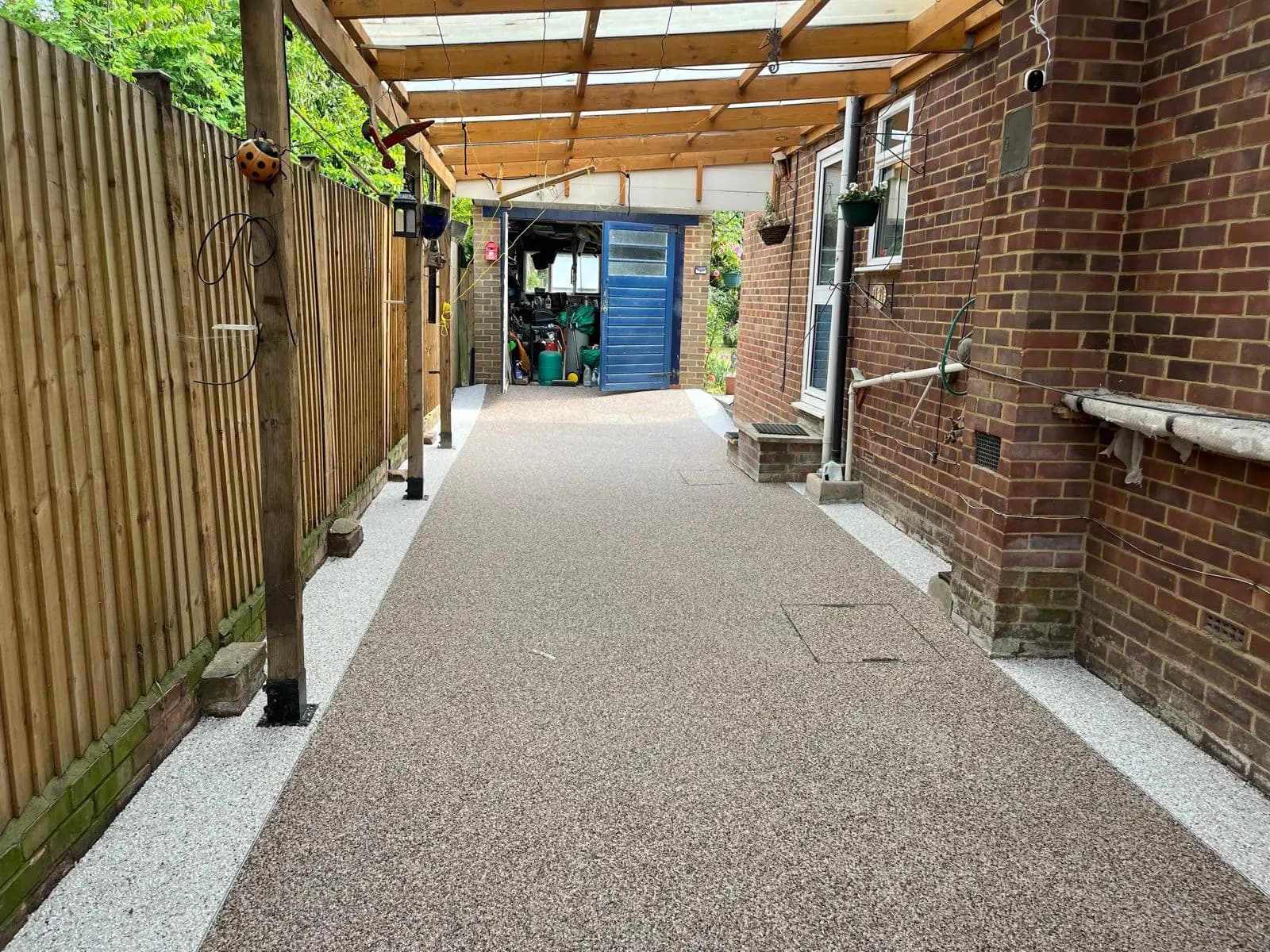
A smooth, low-maintenance silver-grey resin path that runs cleanly along the side of the house — a clear lift from the old, stained concrete.
See the full projectWhat it is
A patio or pathway lives at ground level, takes the weather year-round, and is looked at from the house every day — which means the material choice and the laying method both matter more than they do on a driveway tucked around the front. The two finishes we lay most in Surrey are porcelain and natural sandstone, and while they can look similar in a showroom photograph, they behave very differently in a garden and need different installation methods to stay flat and bonded.
Falls and drainage are the detail most garden paving gets wrong. A patio that drains correctly — water moving away from the house, not pooling in the middle or against a wall — is the difference between a surface that lasts a decade and one that starts to lift after the second wet winter. We set our falls at the survey stage, before a single slab goes down, not as an afterthought at the finish.
We carry porcelain ranges from several UK distributors alongside traditional sandstone, limestone, and sawn granite options. At the site visit we bring samples you can lay on the ground and view against the house, and we talk through the maintenance expectations for each — because the honest answer on which is better depends entirely on the garden, the shade, and how much work you want to put in over the years.
Best for
Recent work
A selection of finished patios jobs — every one our own work.
How we work
We visit to measure the area, check the existing ground level, and identify where water naturally wants to go. We bring material samples to view on site and agree the falls plan before quoting — so there are no surprises about how far the finished surface will sit above or below the house threshold.
We excavate to a depth suited to the slab thickness and the ground conditions — typically 150–200mm including the sand-and-cement bed — and compact the sub-base. Any soft or waterlogged areas are addressed at this stage. Edge restraints and any point drainage channels are set before bedding begins.
For porcelain, each slab is back-buttered with a slurry primer before bedding — the critical step that bonds the tile to the mortar and prevents hollow spots. Sandstone and other natural stone slabs are laid onto a solid sand-and-cement bed and tapped level. We cut around manholes, steps, and irregular shapes with a disc saw rather than snapping.
Once the bed has cured, joints are filled with a flexible jointing compound suited to the material — standard brush-in mortar for most natural stone, a dedicated grout or Geo-fix style compound for porcelain with its tighter joints. Natural sandstone and limestone are sealed on request to slow staining and algae. We clean the surface down and walk through the finished job with you.
Materials & spec
Porcelain wins on practicality: it does not stain, moss finds it harder to grip, and the colour you choose on day one is still the colour you have in ten years. The downside is brittleness — a heavy dropped object can chip or crack a slab, and unlike natural stone, you cannot just blend in a replacement from a slightly different batch. The slurry primer step is non-negotiable; skip it and the slab-to-mortar bond fails, particularly through freeze-thaw cycles.
Natural stone — sandstone especially — has a warmth and variation that suits period homes and informal gardens in a way porcelain rarely matches. The trade-off is maintenance: it absorbs water, picks up iron staining from rust and leaves, and grows algae readily on a shaded north-facing patio. A good penetrating sealer applied once the mortar has fully cured slows all of this down, but it needs re-doing every few years. If you are not prepared to do that, porcelain is the lower-effort choice over the long run.
A path that works needs to be wide enough to walk comfortably with a wheelbarrow or garden bags alongside you — 900mm is a minimum, 1200mm is much more usable. Falls on a path run across the width rather than along the length in most cases, so the edge is the low side and water sheds to the border rather than running along the surface and pooling at a step.
Edge restraints on a path matter more than on a patio, because a path sees concentrated foot traffic along its length and the edges have less area to resist spread. Haunched concrete on both sides, or a block edging set in concrete, keeps the slab course from spreading and lifting over time. It is the detail that is most often skipped on a quick quote and the first thing to fail.
See also
Comparing options? Have a look at the other services we offer alongside patios.
Residential
Marshalls and Bradstone block paving installed to BS 7533.
Residential
Permeable resin-bound aggregates, smooth and SuDS-compliant.
Residential
Bound or loose gravel with stable sub-base and edging.
Residential
Patching, re-jointing, re-sanding, and section replacement.
FAQ
Light foot traffic is usually fine after 24–48 hours once the mortar bed has taken its initial set. We recommend leaving garden furniture off it for a week and avoiding anything heavy for at least that long. In cold weather — below five degrees overnight — curing slows considerably and we may recommend a longer wait or schedule the work for warmer conditions.
Outdoor porcelain is manufactured with a textured or structured surface and carries an R-rating (slip resistance). We only specify R11 or higher rated slabs for patios and paths — the smooth-faced interior-style tiles that look similar in photos have no business going outside. If you are comparing quotes, ask for the slip-rating of the slab being priced.
Sealing is worth doing and noticeably slows staining, algae growth, and water absorption — particularly on a south-west facing patio that gets leaf debris or a shaded area that stays damp. It is not permanent protection; a penetrating impregnator typically lasts two to four years before it needs reapplying. We can apply it as part of the job or advise on the product if you would rather do it yourself later.
Sometimes, but natural stone in particular varies batch to batch and the existing slabs will have weathered. We will always be honest about how close a match is achievable before you commit. Where a perfect match is not possible, designing a clear break between old and new — a different row, a different width — often looks better than a near-match that visibly differs.
Steps and level changes are designed in at the survey stage so we know the rise and going before we start. We build steps from the same material as the main surface wherever possible so the scheme reads as one. The falls on each tread are set slightly forward to shed rain, and nosings are left square rather than bullnosed unless you specifically ask for the rounded edge.
Tell us where you are and roughly what you'd like done. Free site visit, written quote, no pressure.
We also work in
Surfacing in
Period homes off the Hog's Back, new builds around the A3 corridor.
See work in Guildford→Surfacing in
From Hook Heath driveways to commercial yards near Sheerwater.
See work in Woking→Surfacing in
Stoke D'Abernon homes and the Fairmile estates.
See work in Cobham→Surfacing in
St George's Hill and Burwood Park resin and block paving.
See work in Weybridge→Surfacing in
Claygate, Hinchley Wood, and Esher village driveways.
See work in Esher→Surfacing in
Conservation areas and rural plots around the town.
See work in Farnham→