

Surfacing in
Guildford
Period homes off the Hog's Back, new builds around the A3 corridor.
See work in Guildford→We will beat ANY like for like quotation. Contact us for more information.
Commercial service
Cost-effective sealing of existing carriageways.
 BeforeAfter
Before & after
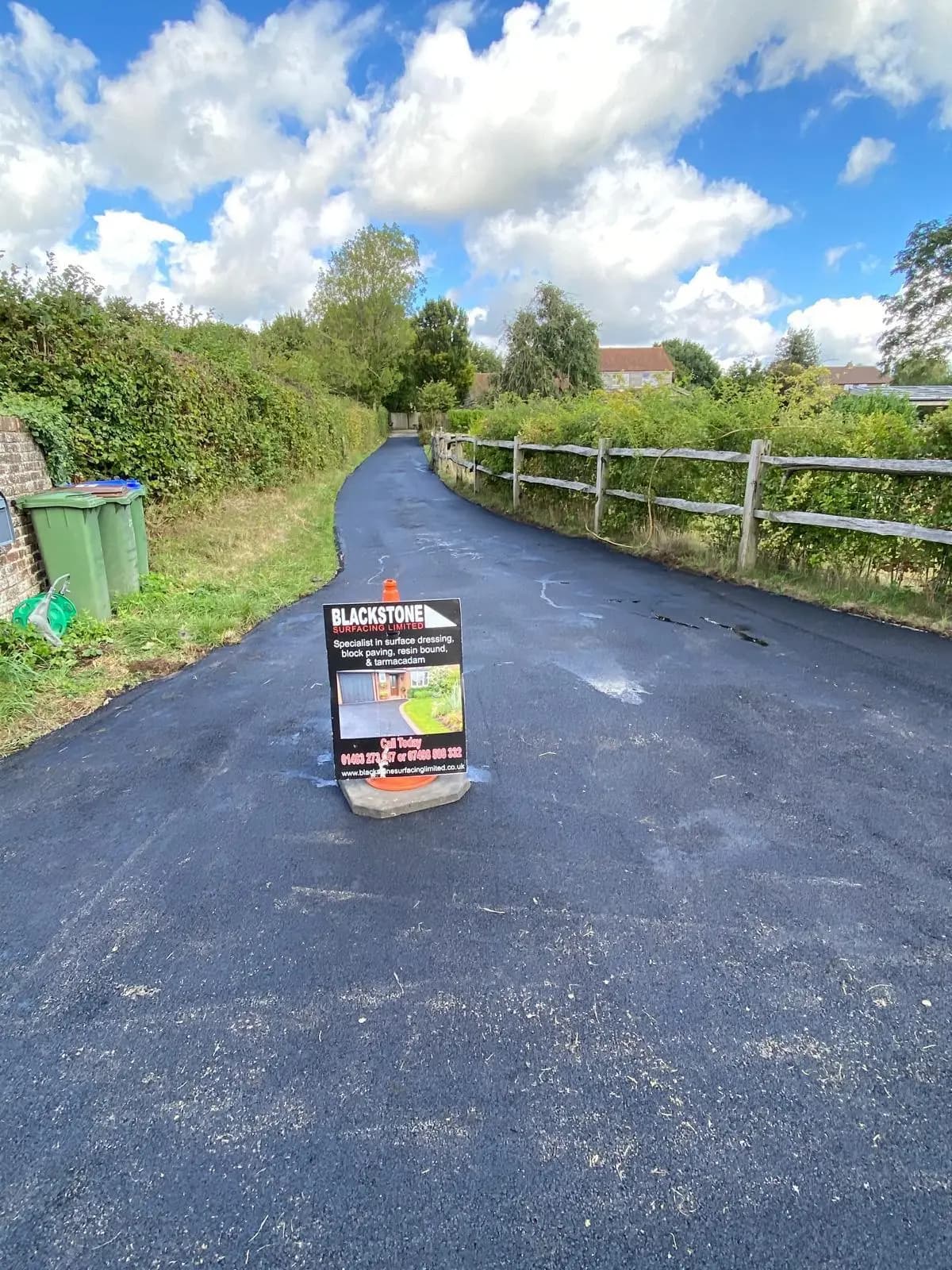
A smooth, durable tarmac lane that sheds water and rides cleanly end to end — no more potholes or standing water.
See the full projectWhat it is
Surface dressing is the most cost-effective life-extension treatment available for an existing road or yard surface. Rather than removing and replacing the wearing course, a layer of bitumen emulsion is sprayed onto the existing surface and immediately covered with a single layer of pre-coated chippings, which are then rolled in. The result seals the existing surface against water ingress, restores surface texture, and — crucially — restores skid resistance to a surface that has been polished smooth by traffic. Done at the right time, it extends the serviceable life of a road by eight to twelve years.
The window of opportunity matters. Surface dressing works on a surface that is structurally sound but whose wearing course is oxidising, losing texture, or starting to show surface cracking. It is not a repair for structural failure — a road with significant base movement, deep rutting, or fatigue cracking needs those issues resolved before any surface treatment is applied. Applied to the right surface at the right stage, it is excellent value. Applied to the wrong surface, it is money spent delaying an inevitable rebuild.
We carry out surface dressing on private estate roads, unadopted residential roads, farm access tracks, industrial yards, and rural carriageways across Surrey. The process is faster and considerably less disruptive than a full overlay — a typical estate road can be treated and reopened to traffic within a few hours — which makes it well-suited to occupied sites where extended road closures are not practical.
Best for
Recent work
A selection of finished surface dressing jobs — every one our own work.
How we work
The existing surface is swept thoroughly to remove loose grit, leaf debris, and surface contamination. Any isolated potholes or edge failures are filled and compacted before treatment — surface dressing cannot bridge structural defects, and the emulsion will not bond over loose material. Ironwork is either masked off or noted for re-setting if it is proud of the surface.
A polymer-modified bitumen emulsion is applied by a calibrated spray tanker at the design spread rate, typically 0.9 to 1.2 litres per square metre depending on the existing surface texture and absorption. Polymer modification improves early adhesion and reduces chipping loss — important in the first 24 to 48 hours before traffic embeds the aggregate. The spray rate is matched to the aggregate size being used so the chippings achieve the correct embedment depth.
Pre-coated chippings — usually 6mm, 10mm, or 14mm nominal size depending on the road type and speed — are spread immediately behind the spray tanker and rolled with a pneumatic-tyred roller to achieve 50–60% embedment. Over-rolling is as damaging as under-rolling: too much pressure crushes chippings and too little leaves them proud. Roller passes are managed to achieve consistent embedment across the full width.
The road is opened to slow-speed traffic shortly after rolling, typically at 20 mph or as advised by the operatives. Traffic action embeds the chippings further in the first few days. A follow-up sweep is carried out five to ten days after treatment to remove any loose chippings that have not embedded — this is an essential part of the process, not optional aftercare. We schedule this sweep as part of the contract and confirm the date with you before we leave.
Materials & spec
Surface dressing is the right treatment when the existing road is structurally sound, the base is stable, and the wearing course is ageing but not failing. The indicators are: surface cracking that is shallow and not widening rapidly, loss of surface texture (the road looks smooth and grey rather than open-textured), and skid-resistance concerns on bends or at junctions. If you treat at this stage, you seal the surface before water can penetrate into the base and cause structural damage — that is the whole point of the exercise.
The treatment is the wrong answer when the base has already been compromised. Fatigue cracking, rutting deeper than 10mm, areas that deflect slightly underfoot, or potholes that keep returning in the same locations all indicate base failure. Surface dressing these areas seals in the problem rather than solving it, and the surface will continue to deteriorate beneath the new treatment. In these cases, the right sequence is: repair or reconstruct the failed areas first, then apply surface dressing to the sound sections — or plan for a full overlay once the budget allows.
Surface dressing is a warm-weather treatment. The emulsion requires a minimum air and surface temperature of around 10°C to break and bond properly, and ideally dry weather for 24 hours after application. In practice this means the treatment season in Surrey runs roughly from late April through September. Scheduling within that window, and having a contingency for a weather delay, is something we build into the programme from the outset.
The aftercare period — the five to ten days before the follow-up sweep — requires some management of expectations from residents or site users. Loose chippings in this period can cause minor paint chips to low-slung vehicles if they are travelling too fast, and the 20 mph advisory is there for a reason. We provide clear written guidance on this for distribution to residents or staff, and we confirm the aftercare sweep date before leaving site so there is no ambiguity about when the process is complete.
See also
Comparing options? Have a look at the other services we offer alongside surface dressing.
Commercial
Adopted and unadopted roads, NRSWA-compliant.
Commercial
Reactive and programmed pothole repair contracts.
Commercial
New build and resurfacing, with line marking included.
Commercial
Private estates, residents' associations, school grounds.
FAQ
On a sound base, well-applied surface dressing typically extends road life by eight to twelve years. The exact figure depends on traffic loading, the quality of the existing base, and whether the road is exposed to winter gritting or de-icing salts. Surface dressing does not reset the structural clock — if the base was marginal before treatment, the surface will deteriorate faster than it would on a sound base. We will give you an honest estimate of the likely service life at the survey stage.
Yes, there will be loose chippings for five to ten days after treatment until the follow-up sweep. During this period the road should be used at 20 mph or below. Fast-moving traffic in this window can throw chippings and cause minor paint damage to vehicles. We provide written notices for distribution to site users or residents, and we agree a speed advisory and follow-up sweep date before we leave. The sweep is part of our contract — it is not optional and we do not consider the job done until it has been carried out.
Potholes must be filled and allowed to cure before surface dressing is applied. The emulsion will not bond over a loose or compressible fill, and an unfilled pothole simply creates a void beneath the new surface that will re-open quickly. We fill isolated defects as part of the pre-treatment preparation, and if we find during the pre-sweep that the number of defects is higher than expected, we will discuss the additional cost with you before proceeding rather than applying the dressing over an inadequate base.
Surface dressing is less suited to car parks than to roads. The stop-start loading pattern in car parks — particularly at turning circles and outside parking bays — tends to pull at the chippings rather than rolling them in, which can result in premature chipping loss. For car parks, a thin AC wearing-course overlay is generally a better choice. We will tell you which treatment is appropriate for your surface type when we visit.
The best approach is to treat surface dressing as a scheduled intervention in a planned maintenance programme rather than a reactive one. A road that is surface-dressed when the wearing course first starts to age will cost considerably less over a 20-year period than one that is allowed to reach structural failure before any treatment is applied. We can advise on a simple inspection and maintenance programme for private road networks — noting current condition, expected treatment dates, and approximate costs — so that budget can be allocated in advance rather than in response to failure.
Tell us where you are and roughly what you'd like done. Free site visit, written quote, no pressure.
We also work in
Surfacing in
Period homes off the Hog's Back, new builds around the A3 corridor.
See work in Guildford→Surfacing in
From Hook Heath driveways to commercial yards near Sheerwater.
See work in Woking→Surfacing in
Stoke D'Abernon homes and the Fairmile estates.
See work in Cobham→Surfacing in
St George's Hill and Burwood Park resin and block paving.
See work in Weybridge→Surfacing in
Claygate, Hinchley Wood, and Esher village driveways.
See work in Esher→Surfacing in
Conservation areas and rural plots around the town.
See work in Farnham→