

Surfacing in
Guildford
Period homes off the Hog's Back, new builds around the A3 corridor.
See work in Guildford→We will beat ANY like for like quotation. Contact us for more information.
Residential service
Marshalls and Bradstone block paving installed to BS 7533.
 BeforeAfter
Before & after
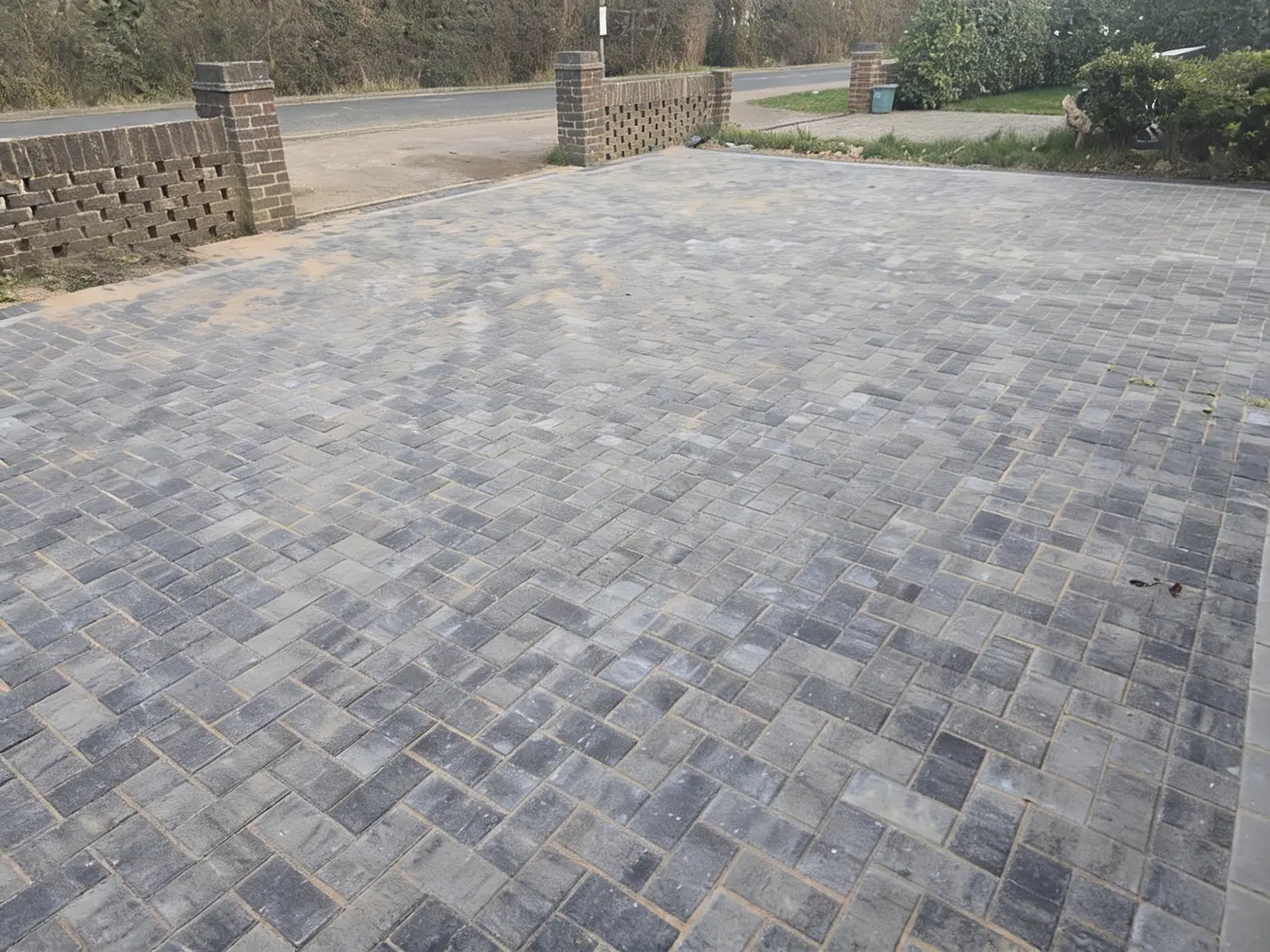
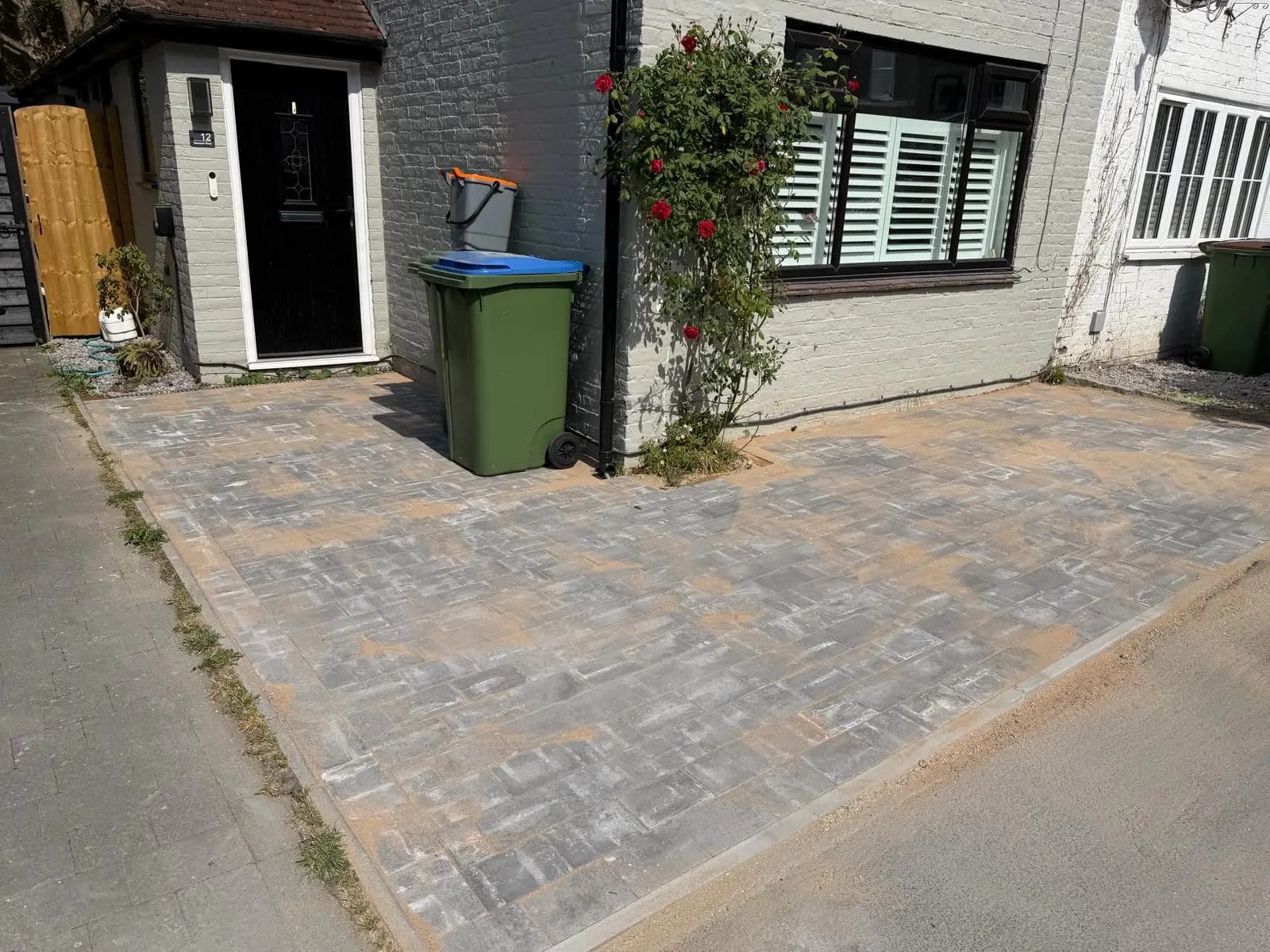
A clean, modern grey block paving driveway with crisp edges — a tidy, low-maintenance frontage in place of the worn old blockwork.
See the full projectWhat it is
Block paving is the driveway most people picture when they picture a smart drive: a clean, interlocking surface in a herringbone or stretcher pattern, edged crisply against the lawn, that lifts the whole front of the house. Done properly it is also one of the most durable finishes you can lay — the strength comes from thousands of individual blocks locking against each other, not from a single brittle slab that cracks the first time something heavy parks on it.
The catch is that block paving lives or dies on what you can't see. The blocks are the easy part. The sub-base, the laying course, the edge restraints, and the falls are what decide whether the drive still sits flat in ten years or starts to dip, rut, and sprout weeds after two. We build to BS 7533 — the British Standard for paving — because that is the difference between a driveway and a patio someone parked a car on.
We lay Marshalls and Bradstone ranges as approved installers, which covers everything from traditional Tegula setts for a period property to large-format linear blocks for a contemporary frontage. We will bring samples to the site visit so you can see them against your brick and render before you commit.
Best for
Recent work
A selection of finished block paving jobs — every one our own work.
Block paving driveway · Horsham, West Sussex
Block paving driveway · Cranleigh
Block paving driveway · Farnborough, Hampshire
Block paving · Surrey
Block paving driveway · Surrey
Block paving driveway · Surrey
How we work
We measure up, check the existing ground and drainage, and bring block samples to hold against the house. You will know the pattern, colour, and edge detail before we quote.
We dig out to the right depth for the load, lay a geotextile membrane where the ground is soft, then build and compact a Type 1 sub-base in layers — usually 150–250mm.
Blocks are laid on a screeded sharp-sand course to the agreed pattern, with edge courses haunched in concrete. Cuts around manholes and curves are done with a saw, not snapped.
Kiln-dried sand is brushed in and the whole drive is plate-compacted, twice, to lock the blocks. We finish with a walk-through and tell you when to top the joints up.
Materials & spec
These are the two finishes we are asked to compare most. Resin is seamless and permeable out of the box; block paving is traditional, repairable, and better under point loads. Per square metre they usually land within about 10% of each other once the prep is the same.
Our rule of thumb: choose block paving if your property is period, if the drive takes heavy or shared parking, or if you value being able to lift and replace a single section years down the line. Choose resin if the house is modern, the traffic is normal cars, and you want the lowest-maintenance surface going. Neither is 'better' in the abstract.
Traditional block paving laid on a closed sub-base sheds water sideways, so any new drive over 5m² needs that water dealt with — a permeable strip, a soakaway, or a fall to a planted border on your own land. We design this in at quote stage rather than bolting it on later.
If staying fully permeable matters to you, we can lay permeable block paving with wider joints over an open-graded sub-base, which lets water drain straight through and keeps you compliant without a separate soakaway.
See also
Comparing options? Have a look at the other services we offer alongside block paving.
Residential
Permeable resin-bound aggregates, smooth and SuDS-compliant.
Residential
Hot-laid tarmacadam for long, hard-wearing driveways.
Residential
Porcelain, sandstone, and block paving patios and paths.
Residential
Patching, re-jointing, re-sanding, and section replacement.
FAQ
Most residential block paving drives take 5 to 10 working days depending on size, access, and how much excavation the ground needs. We give you a day-by-day schedule with the written quote so you can plan around it.
Weeds in block paving almost always grow in debris that settles on top of the joints, not up from underneath a properly compacted base. Regular sweeping and an occasional joint top-up keeps them out; we can also use polymeric jointing sand, which sets firmer and slows growth considerably.
Often, yes. Many Marshalls and Bradstone ranges are still in production, and where a block is discontinued we can usually lift sound blocks from the original to use on the visible areas and put the closest match on the less-seen edges. We will tell you honestly at the site visit how good a match is achievable.
For a driveway under 5m² you do not. Above that, the rules require the surface to be permeable or to drain to a soakaway on your own land — which a standard block drive needs designed in. We handle that within the quote and flag the rare cases where a full planning application is sensible.
A correctly built block paving drive comfortably handles cars, vans, and the occasional caravan or removal lorry — block paving actually outperforms tarmac under concentrated point loads. The key is the sub-base depth, which we set to the heaviest thing you expect to park on it.
Tell us where you are and roughly what you'd like done. Free site visit, written quote, no pressure.
We also work in
Surfacing in
Period homes off the Hog's Back, new builds around the A3 corridor.
See work in Guildford→Surfacing in
From Hook Heath driveways to commercial yards near Sheerwater.
See work in Woking→Surfacing in
Stoke D'Abernon homes and the Fairmile estates.
See work in Cobham→Surfacing in
St George's Hill and Burwood Park resin and block paving.
See work in Weybridge→Surfacing in
Claygate, Hinchley Wood, and Esher village driveways.
See work in Esher→Surfacing in
Conservation areas and rural plots around the town.
See work in Farnham→