We will beat ANY like for like quotation. Contact us for more information.
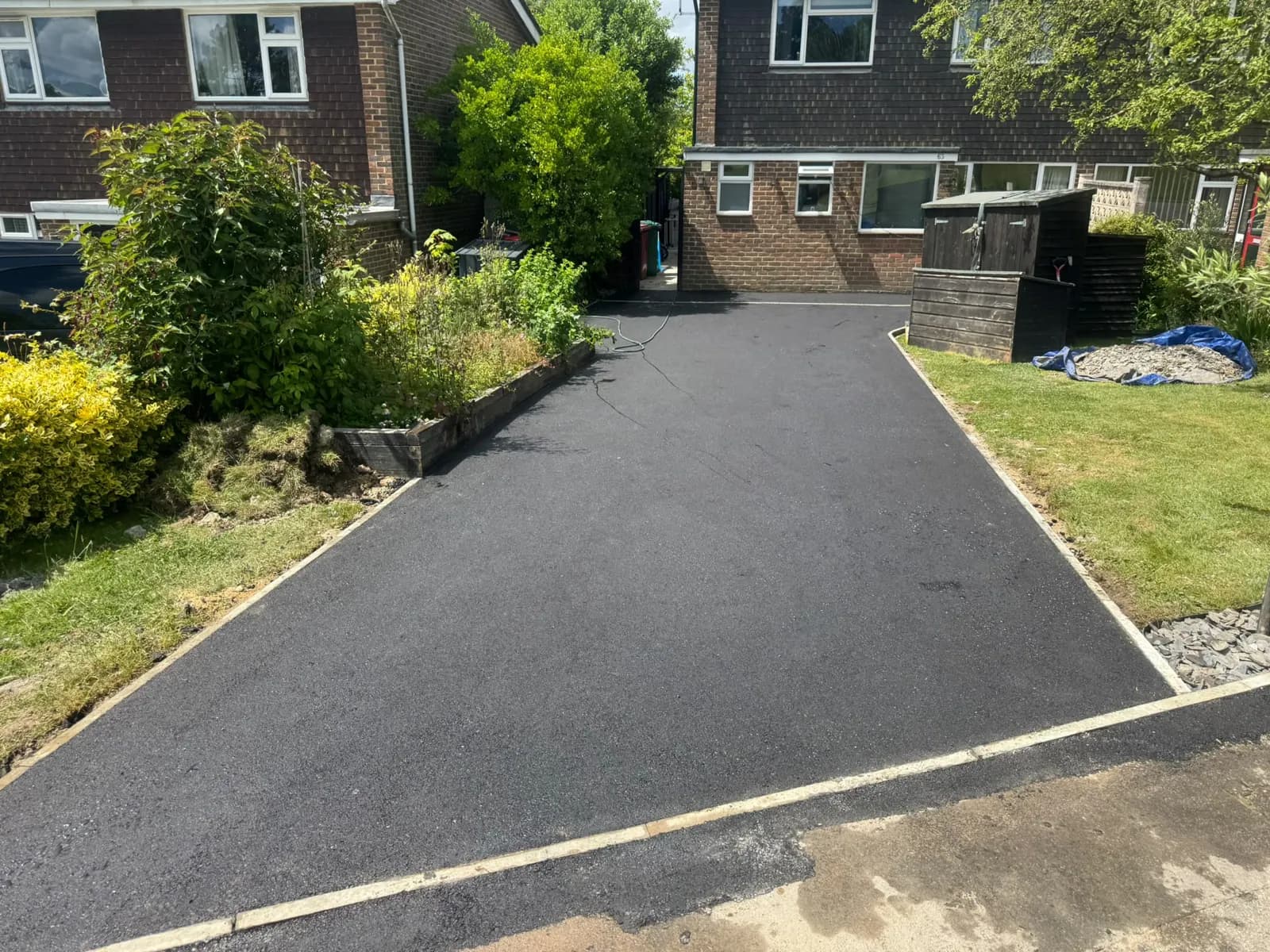
Tarmac driveway · Haslemere, Surrey
A long driveway between the lawns had broken up and lost its edges. The owners wanted it taken back to a proper base and re-laid as a clean, hard-wearing tarmac drive with defined edging and drainage.
The project, start to finish
Tap any photo to view it full size.
The brief
A long driveway between the lawns had broken up and lost its edges. The owners wanted it taken back to a proper base and re-laid as a clean, hard-wearing tarmac drive with defined edging and drainage.
The work
We dug the drive out to formation and carted away the old material, then rebuilt and compacted the sub-base. Timber edging and a drainage channel were set to define the drive and carry water away, before we hot-laid the tarmacadam and rolled it in sections to a smooth, even finish running the full length between the gardens.
The outcome
A smooth, well-drained tarmac driveway with crisp edges that runs cleanly from the road up to the house — a complete transformation from the broken-up surface it replaced.
This was a tarmac driveway project in Haslemere. We cover Surrey, UK for residential and commercial surfacing.
How we work
Tarmac — more precisely, hot-rolled asphalt or dense bitumen macadam — is the most field-proven driveway surface in the country. It has been laid under British weather for over a century because it works: it bonds tightly when compacted hot, sheds water to where you direct it, handles the weight of vans and the abuse of skip lorries, and is easier and cheaper to repair than most alternatives when something eventually does go wrong.
We cut out to the depth needed for the ground conditions and the vehicle load — typically 150–200mm for cars, more if the soil is soft or there is regular van or commercial traffic. A Type 1 MOT granular sub-base is spread and compacted in 75mm layers using a vibrating plate or roller until we achieve a stable, even platform with the correct falls designed in.
Concrete or block kerbing is set and haunched before any asphalt is laid. Without a contained edge, tarmac creeps outward at the perimeter and crumbles within a few seasons. Any gullies or drainage channels are positioned and set to the correct level at this stage, before the binder course goes down.
Hot binder-course macadam — typically AC20 or AC14 close-graded, 60–70mm — is raked out and compacted immediately with a roller whilst the material is still within temperature. The binder course is the structural layer: it carries the load and provides the stable platform the surface course needs to bond to.
A 25–30mm surface course of AC10 close-graded macadam is laid over the binder, overlapping any joins, and compacted with a steel-drum roller in overlapping passes. Rolling continues until the surface is fully dense and any roller marks are worked out. The drive cools over the following hours and is typically ready for light traffic the same day.
Questions
Hot-laid tarmac is typically safe for light foot traffic within a couple of hours of rolling and ready for car parking by the end of the working day in normal temperatures. We advise waiting 48 hours before parking anything heavy — vans, caravans, skips — and a full 7 days before the surface achieves its final hardened state. In hot weather, avoid parking in the same spot repeatedly during the first couple of weeks, as tarmac softens slightly in high heat before it fully ages.
An overlay is possible if the existing surface is structurally intact — no subsidence, no large cracks, no soft spots — and if there is adequate clearance at the threshold and garage door to allow the additional depth. Where the existing base is failing, an overlay simply delays the problem. We assess this at the site visit and give you an honest recommendation. We would rather advise a full build than take payment for an overlay that fails in 18 months.
Coloured tarmac uses the same bitumen macadam mix with a mineral or iron-oxide pigment added to the aggregate. The structural properties are identical to standard black. Red is often used to differentiate driveways from roads on shared or commercial access, and buff or brindle blends can soften the contrast with a brick or stone house front. The colour does fade gently over years as the surface oxidises, which is normal and expected.
Standard tarmac is very low maintenance. Keep the edges clear of soil and vegetation — roots and soil creep can undermine the edge restraint over time. Deal with oil spills promptly because prolonged petroleum contact softens bitumen. If cracks appear, fill them before water gets in and freezes. A professional surface dressing every 10–15 years refreshes the wearing surface and extends life considerably without the cost of a full overlay.
Yes — tarmac handles slopes well and is commonly used on stepped or ramped access drives. The critical consideration on a steep slope is drainage: falls need to be designed so that water is directed away from the house and does not sheet straight down the drive towards the road. Edge channels or a valley gutter at the base of the slope are usual solutions. We factor gradient into the specification and drainage design at quote stage.
Tell us roughly what you'd like done. We'll come out and quote in writing.