

Surfacing in
Guildford
Period homes off the Hog's Back, new builds around the A3 corridor.
See work in Guildford→We will beat ANY like for like quotation. Contact us for more information.
Residential service
Patching, re-jointing, re-sanding, and section replacement.
 BeforeAfter
Before & after
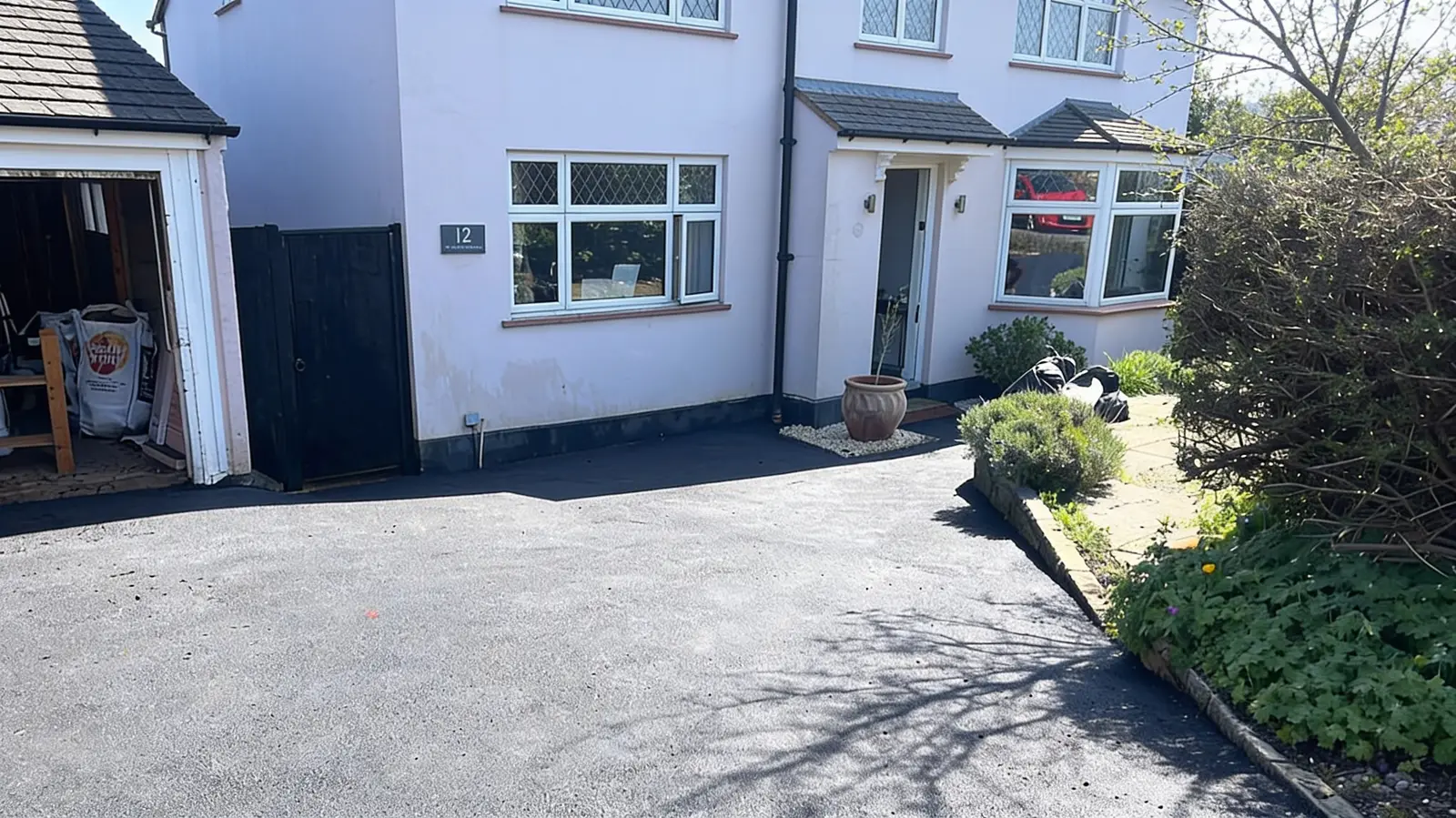
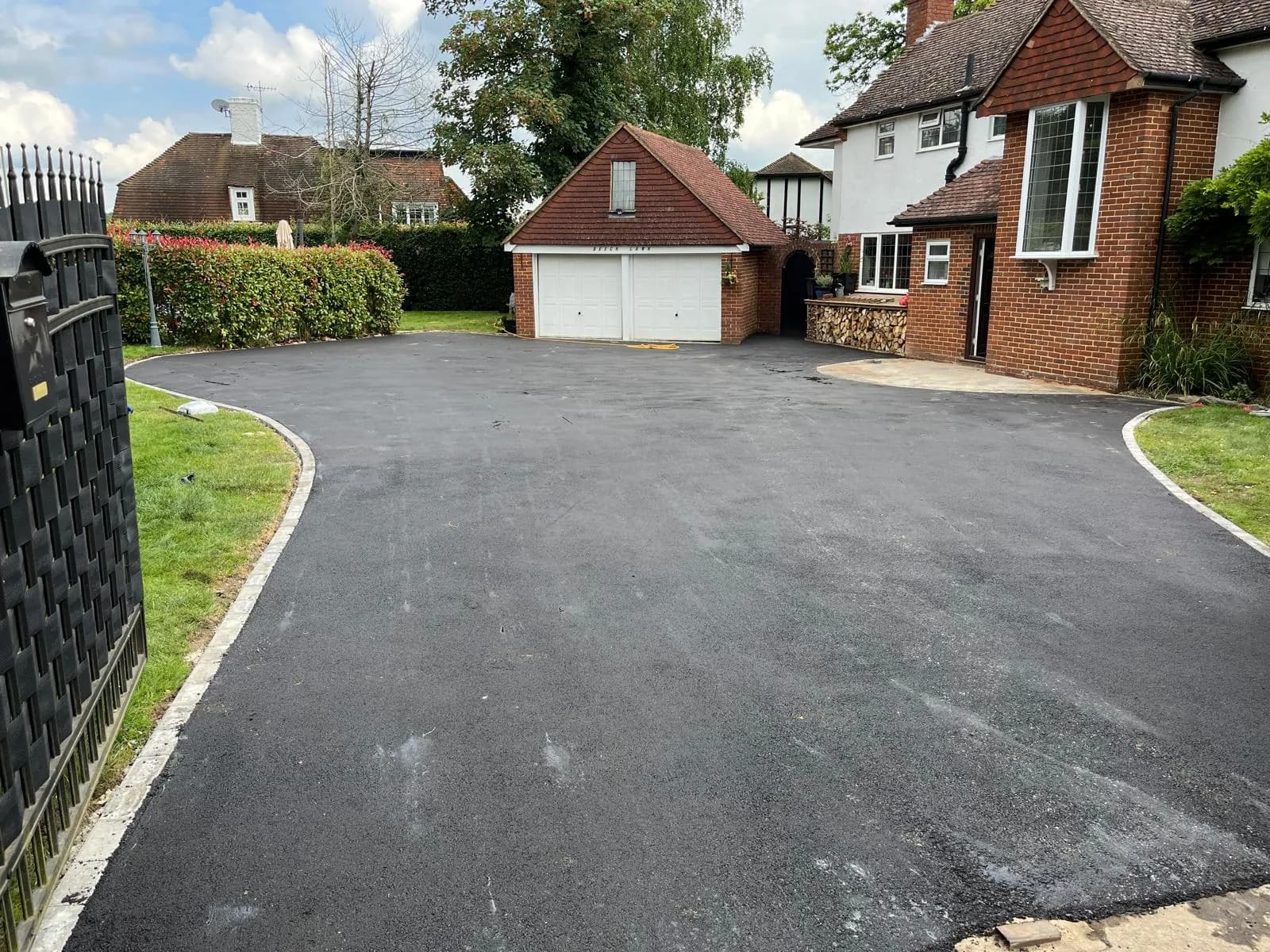
A smooth, hard-wearing tarmac driveway with generous parking and clean edges — a clear step up from the loose gravel it replaced.
See the full projectWhat it is
Most driveway problems look worse than they are. A section of block paving that has dipped, a patch of tarmac that has started to ravel at the surface, joints that have washed out and are now full of weeds — these are almost always fixable without pulling up the whole drive. The key is diagnosing what is actually wrong before quoting a remedy, because the same visible symptom can have two completely different causes with different fixes and different costs.
The failure modes we see most in Surrey are sub-base movement under clay-heavy ground, surface course ravelling on tarmac that was laid too thin or without sufficient compaction, block paving that has spread because edge restraints were skipped or bedded in weak mortar, and joints that have washed out over several winters and let weeds establish. Each of these has a repair that is proportionate to the scale of the problem — and part of our job at the site visit is being straight with you about when a repair is good value and when the underlying issue is bad enough that a patch is just delaying the inevitable.
We carry the materials for the most common repair types on the van: AC10 patching compound for tarmac, kiln-dried jointing sand for block paving re-sanding, Geo-fix style polymeric compound for more durable re-jointing, and the same Marshalls and Bradstone ranges for block replacement. That means most straightforward repairs are a single visit rather than a two-week lead time.
Best for
How we work
Before we touch anything, we look at what is actually failing. We probe soft areas in tarmac to find where the base has gone, lift sample blocks to check whether the bedding sand is still intact or has washed into the sub-base, and check edge restraints for movement. We will tell you clearly whether the cause is surface-only — in which case a patch or re-jointing is the right call — or whether the sub-base has failed and the repair needs to go deeper to last.
For tarmac patching, we cut the repair area back to sound material with a disc saw — never just feathering the edge, which fails quickly. For block paving section repairs, we lift the affected blocks carefully and assess the bedding and sub-base underneath. Where the sub-base has sunk or softened we excavate and re-compact a new Type 1 base before re-bedding. Edge repairs are haunched back in concrete where the original mortar has crumbled.
Tarmac patches are filled with AC10 close-graded asphalt, primed at the edges with a tack coat to bond new to old, and compacted. Block paving sections are re-laid on a fresh screeded sand bed at the correct level, with blocks matched as closely as possible from existing stock or the nearest current range. Re-jointing — where the structure is sound but joints have failed — uses either kiln-dried sand brushed and compacted in, or a polymeric jointing compound for a more durable finish that resists washout.
Once the repair is complete we walk the whole drive with you, not just the patch. That lets us flag anything else that is starting to show the same symptoms — a second section that is borderline, a low spot that is pooling, an edge that is starting to move — so you have the full picture before we leave. We would rather tell you now than have you call us back in a year for the same job on the next section.
Materials & spec
The honest test is the sub-base. If we lift a block or core a tarmac patch and the material underneath is still solid and level, a surface repair will hold — and it is usually well worth doing rather than replacing a drive that is structurally fine. If the sub-base has moved, sunk into soft ground beneath it, or been contaminated by water washing the fines downward, then repairing the surface is treating the symptom. It will fail again, probably in the same place, within a season or two.
A rough guide: if more than a third of the drive surface has problems, or if the same patch keeps failing within a couple of years of being repaired, that is usually the point where a full strip and rebuild is better economics. We will say that at the site visit if it is the case, because we would rather give you that conversation once than have you spend money on repairs that are only postponing the same outcome.
A tarmac patch will always be visible for a period after laying, even on a well-executed job. Fresh asphalt is darker than weathered tarmac, and the difference takes time — typically six to eighteen months of UV exposure and traffic — to reduce. The cut line will be invisible if the edges were sawn cleanly and primed correctly; the colour difference is a material property, not a sign of poor work.
If the appearance of a patch bothers you and the drive is otherwise sound, a surface dressing or a coat of driveway sealant applied over the whole surface after the patch cures will even out the tone. We can advise on that at the time of repair rather than pricing it in unnecessarily.
See also
Comparing options? Have a look at the other services we offer alongside repairs.
Residential
Marshalls and Bradstone block paving installed to BS 7533.
Residential
Permeable resin-bound aggregates, smooth and SuDS-compliant.
Residential
Hot-laid tarmacadam for long, hard-wearing driveways.
Residential
Porcelain, sandstone, and block paving patios and paths.
FAQ
Not necessarily. Localised sinking is usually either a failed edge restraint, a softened patch of sub-base, or a utility trench settlement where someone dug through the drive for a drainage or cable run. All three are repairable section by section. We lift the affected area, sort out whatever is underneath, and re-lay with the existing blocks. The real question is whether the cause was local or whether the whole sub-base is on the move — we check that during diagnosis before quoting.
A hairline crack can be filled with a bitumen crack filler and sealed over, but it is worth understanding why it cracked before doing so. Edge cracks almost always mean no edge restraint or a failed one. A crack in the middle of the drive running across the width often signals sub-base movement or a tree root. If the cause is not addressed, the crack returns. We will look at what is underneath and tell you whether a fill and seal is a proper fix or just a cosmetic patch.
A repair done correctly on a sound sub-base should last as long as the original surface — there is no inherent reason a patched block paving section or a properly primed tarmac repair should fail sooner than the surrounding material. The repairs that fail quickly are those done on a base that was not checked, or tarmac that was feathered rather than sawn at the edges. We do not cut those corners because a repair that comes back in eighteen months is bad for both of us.
Usually a straightforward re-jointing job. We treat the existing weeds with a targeted application, remove the debris from the joints, and re-fill with either kiln-dried jointing sand or a polymeric compound if you want the longer-lasting option. If the blocks themselves are sound and level, re-jointing is one of the most cost-effective things you can do to refresh a tired-looking drive. We will check the edge restraints and any low spots at the same time.
Repair quotes vary because the scope can legitimately differ: one contractor may be pricing a surface fix, another a sub-base rebuild, and a third something in between. Ask each one exactly what they are doing and why — the depth of the repair, whether they are cutting or feathering tarmac edges, whether they are checking the base under block lifts. A cheaper quote is not always wrong, but if it does not include the sub-base check, you are taking a risk that the patch will not last.
Tell us where you are and roughly what you'd like done. Free site visit, written quote, no pressure.
We also work in
Surfacing in
Period homes off the Hog's Back, new builds around the A3 corridor.
See work in Guildford→Surfacing in
From Hook Heath driveways to commercial yards near Sheerwater.
See work in Woking→Surfacing in
Stoke D'Abernon homes and the Fairmile estates.
See work in Cobham→Surfacing in
St George's Hill and Burwood Park resin and block paving.
See work in Weybridge→Surfacing in
Claygate, Hinchley Wood, and Esher village driveways.
See work in Esher→Surfacing in
Conservation areas and rural plots around the town.
See work in Farnham→