

Surfacing in
Guildford
Period homes off the Hog's Back, new builds around the A3 corridor.
See work in Guildford→We will beat ANY like for like quotation. Contact us for more information.
Commercial service
Private estates, residents' associations, school grounds.
BeforeAfterBefore & after
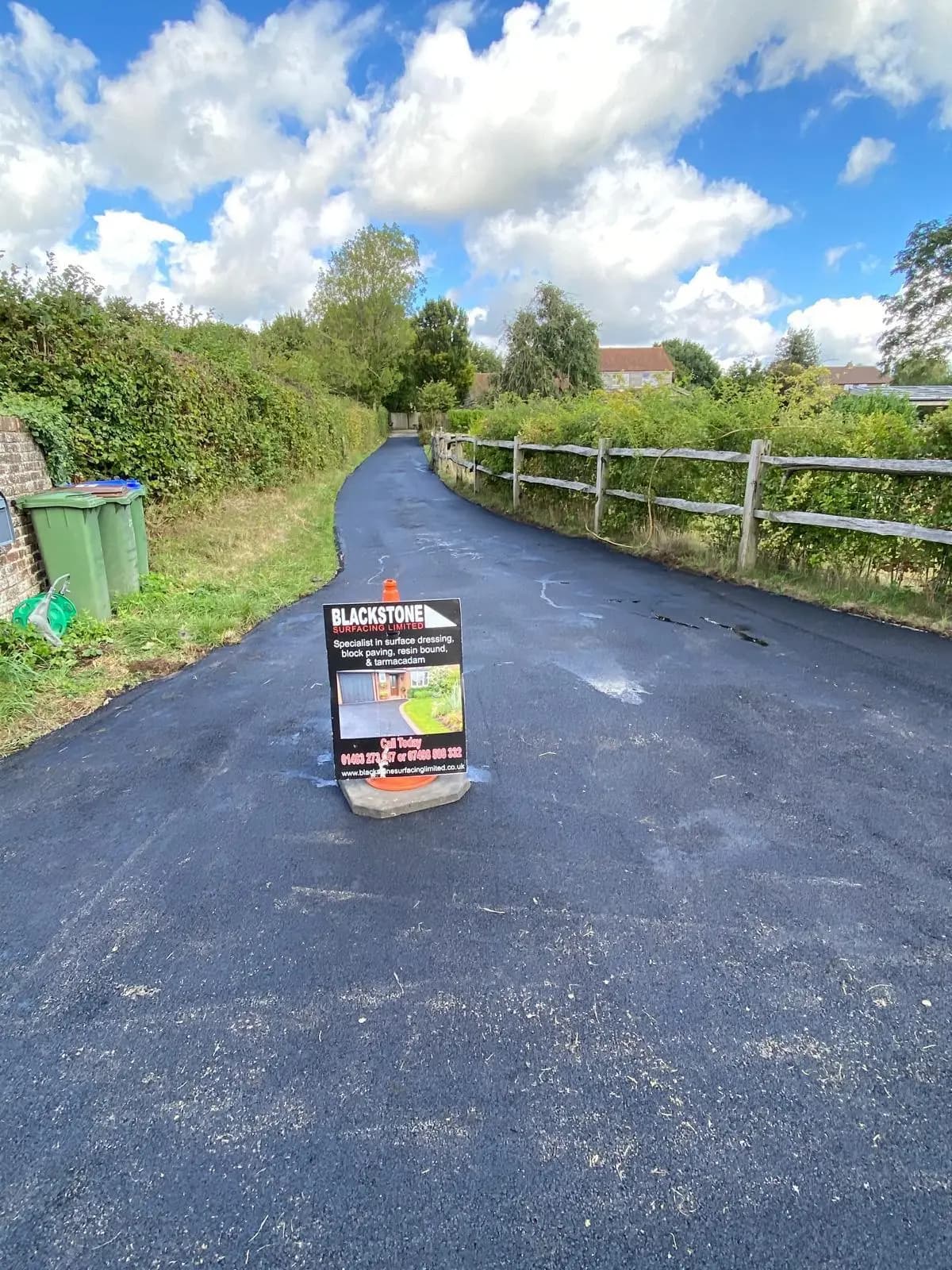
A smooth, durable tarmac lane that sheds water and rides cleanly end to end — no more potholes or standing water.
See the full projectWhat it is
Private roads present a different set of constraints from adopted highways. There is no highway authority to coordinate with, but there is a management committee, a group of residents or tenants, a board of trustees, or a single landowner — and any of them can halt a job mid-way if access or disruption is worse than expected. Planning the work is as much about communication as it is about surfacing specification, and that planning starts at the initial survey, not on the first morning of laying.
The roads themselves range from Victorian estate lanes laid on whatever fill was available at the time, to 1980s residential roads that were never adopted by the council and have had minimal maintenance since, to contemporary access roads for business parks and hotels. Each has a different base condition, a different level of defect accumulation, and a different owner with different budget expectations. We survey the full extent of road before pricing anything, because the difference between an overlay and a full reconstruction can be fifty thousand pounds and is not something to discover half-way through.
We cover the full spectrum — from single-pass surface dressing to extend the life of a structurally sound road, through localised patching and binder-course overlay, to full-depth removal and reconstruction on roads where the base has failed. Phased programmes spread cost over multiple seasons and keep roads open throughout. Committee and management company clients are assigned a single point of contact for the duration, so queries go to one person and decisions come back the same way.
Best for
Recent work
A selection of finished private roads jobs — every one our own work.
How we work
We walk every road with the client representative — or, where the estate is large, conduct a formal driven survey with a condition record. Surface cracking, edge break, rutting, ironwork settlement, and drainage issues are all logged. The output is a prioritised defect schedule with three tiers: immediate (safety defects), medium-term (structural defects that will worsen rapidly), and planned (maintenance that can be deferred to the next financial year). A phased programme is proposed so spend is sequenced and access is never fully removed across the whole estate simultaneously.
Where overlay is the correct approach, the existing surface is planed to the depth of the new construction — typically 40–60mm for a wearing-course overlay, more for a binder-and-surface two-coat job. Planing produces a flat, keyed surface that bonds correctly to the new material and avoids raising kerb lines or threshold heights. Where full reconstruction is required, carriageway material is excavated to formation level, sub-base brought to the correct compacted depth, and a binder course laid before the wearing course. All arisings are removed from site and recycled through a licensed facility.
Roads that carry regular vehicle traffic are built in two asphalt courses. The binder course — AC20 or AC14, typically 60–80mm compacted — provides the structural layer and distributes load into the base. The wearing course — AC10 close-graded, 25–40mm compacted — provides the running surface, skid resistance, and weather-resistance. Both are laid hot, spread to a consistent depth by paving machine, and compacted by roller in multiple passes. Ironwork — drains, manholes, valve boxes — is adjusted to finished level before the wearing course is laid, not after, which is the only way to produce a flush result.
On estate work, roads are opened in phases as each section reaches full temperature and compaction — typically within a few hours of rolling. We coordinate the phasing schedule with the management committee or facilities manager and provide an updated plan if weather or sub-base conditions require any change to the sequence. A final walk-over with the client representative is standard on all estate contracts, with a snagging list closed out before the final invoice is raised. Documentation provided includes a completion report with as-built depths, materials used, and ironwork positions.
Materials & spec
Full road closure is rarely practical on a private estate road — residents still need to reach their homes, deliveries must get through, and emergency vehicles must always have an access route. On a long linear road, we work in sections: half the road width at a time where width allows, or sequential bays of 30–50 metres with each section opened to traffic before the next is closed. Speed of working matters here — hot-mix asphalt can carry traffic within two to three hours of rolling, so a section closed at 07:00 can be open by 10:00.
On estate roads serving multiple properties, we prepare and distribute a phasing notice to all residents before the contract starts, showing which sections will be closed on which days, where alternative parking is available, and who to contact with queries. Management committees consistently find that communication reduces complaints more than any other single factor. A resident who knew about a closure a week ago is a very different conversation from one who finds their driveway blocked without warning.
For emergency vehicle access, we liaise with the client before the job begins to agree any minimum maintained access route, and we identify this route on our phasing plan. An unobstructed route through the site is maintained at all times during working hours, and the road is left trafficable outside working hours.
An unadopted road is one that the relevant highway authority has never taken over for maintenance, meaning the cost of upkeep falls entirely on the frontagers — usually the owners of properties served by the road. The legal position varies: some roads are maintained under a formal private maintenance agreement, others under the terms of a residents' association covenant, and some simply by informal arrangement that holds together until a major repair is needed.
The practical consequence is that deferred maintenance compounds. A road that was structurally adequate when the last overlay was laid twenty years ago has now lost its surfacing life, water has been getting into the base for years, and a full reconstruction is now required rather than an overlay. The difference in cost between a timely overlay programme and a deferred reconstruction is significant — typically three to four times as much per square metre. We often prepare indicative condition reports for residents' associations and management companies that want to plan and budget their road maintenance programme over a five- to ten-year horizon.
See also
Comparing options? Have a look at the other services we offer alongside private roads.
Commercial
Adopted and unadopted roads, NRSWA-compliant.
Commercial
New build and resurfacing, with line marking included.
Commercial
Reactive and programmed pothole repair contracts.
Commercial
Cost-effective sealing of existing carriageways.
FAQ
The owners of properties that front onto or are accessed by the road — the frontagers — are generally responsible for maintenance of an unadopted private road. The exact position depends on the title deeds, any private road maintenance agreement, and whether a residents' association or management company has been set up to administer shared costs. If you are unsure of your position, your solicitor or managing agent can clarify it; we can provide a condition report that sets out what maintenance is needed regardless of who is legally obliged to fund it.
Resurfacing an existing private road with a like-for-like material generally does not require planning permission, as it falls within the scope of maintenance rather than development. Changing the width, alignment, or drainage arrangement, or surfacing a previously unsurfaced track, may require consent. Where the road passes through or adjoins a conservation area or listed property curtilage, additional restrictions may apply. We flag any such issues at the survey stage, but your planning authority or managing agent is the right source of definitive advice.
Yes, and on any estate or multi-property road we plan the phasing before the contract starts. We work in sections, open each section to traffic before moving to the next, and maintain a clear emergency access route throughout. Before work begins, we provide all residents with a plain-language phasing schedule showing which areas will be closed on which days and alternative parking arrangements. The great majority of estate road contracts can be completed without any property being without access for more than a single working day at a time.
An overlay mills off the worn surface and replaces it with a new wearing course — and sometimes a new binder course too — while leaving the existing base intact. It is the right choice when the road structure is fundamentally sound and the defects are surface-level: cracking, fretting, loss of skid resistance. A full reconstruction removes the carriageway to formation level and builds back up through sub-base, binder course, and wearing course. It is required when the base has failed, when rutting or potholing is deep-seated, or when drainage needs to be redesigned. Getting this assessment right at survey stage is the single most important decision in a private road project.
All ironwork — manhole covers, gully tops, valve boxes, stopcock covers — is adjusted to finished road level as part of every resurfacing contract. We rebed or raise each cover before the final wearing course is laid, so the finished surface is flush rather than proud or recessed around the iron. Ironwork left slightly below road level after resurfacing is the most common aesthetic complaint on private road jobs and the most straightforward to prevent. Where ironwork is in poor condition and needs replacement, we flag this at survey so it can be included in the scope.
Tell us where you are and roughly what you'd like done. Free site visit, written quote, no pressure.
We also work in
Surfacing in
Period homes off the Hog's Back, new builds around the A3 corridor.
See work in Guildford→Surfacing in
From Hook Heath driveways to commercial yards near Sheerwater.
See work in Woking→Surfacing in
Stoke D'Abernon homes and the Fairmile estates.
See work in Cobham→Surfacing in
St George's Hill and Burwood Park resin and block paving.
See work in Weybridge→Surfacing in
Claygate, Hinchley Wood, and Esher village driveways.
See work in Esher→Surfacing in
Conservation areas and rural plots around the town.
See work in Farnham→