We will beat ANY like for like quotation. Contact us for more information.
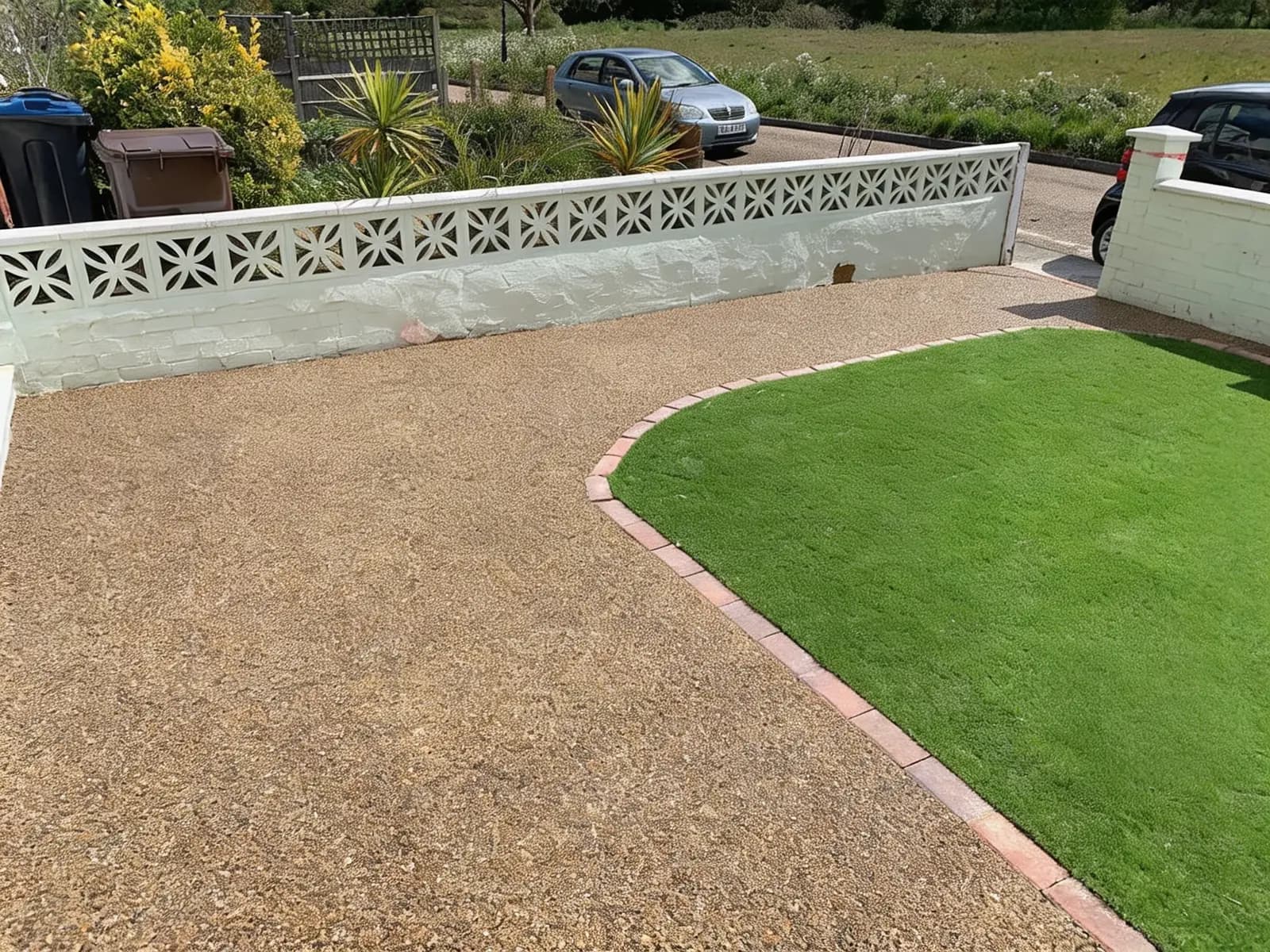
Resin driveway & artificial lawn · Croydon
A front-garden makeover for a low-maintenance frontage that still feels green: a golden resin-bound driveway with a shaped artificial lawn behind a curved brick border, and the side return turned into useable lawn and path.
The project, start to finish
Tap any photo to view it full size.
The brief
A front-garden makeover for a low-maintenance frontage that still feels green: a golden resin-bound driveway with a shaped artificial lawn behind a curved brick border, and the side return turned into useable lawn and path.
The work
We stripped out the old front garden, set out and built a curved brick soldier-course border to shape both the drive and the lawn, then prepared and compacted the sub-base. The golden resin-bound gravel was mixed on site and trowelled out by hand to a smooth, seamless finish, and a shaped artificial lawn was laid behind the border with clean, cut edges. In the side return we ran a matching resin-bound path alongside a fresh strip of artificial grass so the whole approach ties together.
The outcome
A bright, low-maintenance frontage — a seamless golden resin drive, a crisp curved brick border, and artificial lawn that stays neat year-round, front and side.
This was a resin driveway & artificial lawn project in Croydon. We cover Surrey, UK for residential and commercial surfacing.
How we work
Resin bound is the smoothest, most low-maintenance hard driveway you can install today — and on a well-built base it earns that reputation. The finish is a single seamless layer of natural aggregate locked in a two-part polyurethane resin, trowelled flat by hand. There are no joints to harbour weeds, no loose stones to track indoors, and because the aggregate itself is what you see, the colour doesn't fade the way a painted or coated surface would.
Resin is only as good as what it sticks to. We inspect the existing surface — or build a new open-graded macadam or porous concrete base from scratch — and confirm it is structurally sound, fully permeable, and free of standing water. Soft spots and edge failures are remedied before any resin is ordered.
You choose from a range of washed natural aggregates — typically 1–3mm or 2–5mm rounded stone — which we order dry and dust-free. On the day of installation, aggregate and resin are combined in the correct ratio in a forced-action mixer and the batch is used within the working time window, usually 20–25 minutes.
The mixed resin slurry is tipped onto the base and spread to an even depth — typically 15–18mm — using steel trowels. Our crew work in bays, keeping wet edges live so the finish is seamless across the whole area. Manholes and gully tops are masked and edged carefully to keep lines clean.
Resin bound cures fully in approximately 24 hours at normal temperatures, though foot traffic is often possible within a few hours. We check the surface for any pinholes or low spots, apply edge sealant where required, and walk the job with you before we leave. Light vehicle traffic is safe at 24 hours; we advise waiting 48–72 hours for heavy or regular parking.
Questions
On a correctly prepared base, a resin bound surface typically performs well for 15–25 years. The limiting factors are UV exposure over decades (UV-stable aliphatic resins hold colour far longer than aromatic alternatives), and the condition of the base underneath. A resin surface installed over a failing sub-base will fail regardless of the resin quality.
A permeable resin bound surface on a permeable base is inherently frost-resistant because water drains through rather than sitting in it. Freeze-thaw damage happens when water is trapped beneath a surface — which is exactly what an open-graded base prevents. That said, if the sub-base becomes saturated due to poor construction, frost can cause lifting, just as with any other surface.
Sometimes, yes — but only if the existing surface is structurally sound, firmly bonded to the base beneath it, and free of cracks or soft spots. Resin applied over a deteriorating surface will replicate every movement in what's underneath. We always assess the existing base before agreeing to an overlay and will tell you honestly if a full preparation is needed.
No. The rounded aggregate gives a slip-resistant texture when wet — it performs better than polished tarmac or concrete under foot. It is suitable for pedestrian areas, sloped driveways, and access ramps as long as the falls are designed correctly.
Yellowing is almost always caused by aromatic polyurethane resin, which is cheaper to buy and degrades in UV light. UV-stable aliphatic resin doesn't yellow. Patchiness can result from uneven mixing — drum-mixed batches coat the aggregate inconsistently — or from laying in damp or cold conditions that prevent a proper cure. We use UV-stable resin and forced-action mixing on every job.
More like this
Tell us roughly what you'd like done. We'll come out and quote in writing.