We will beat ANY like for like quotation. Contact us for more information.
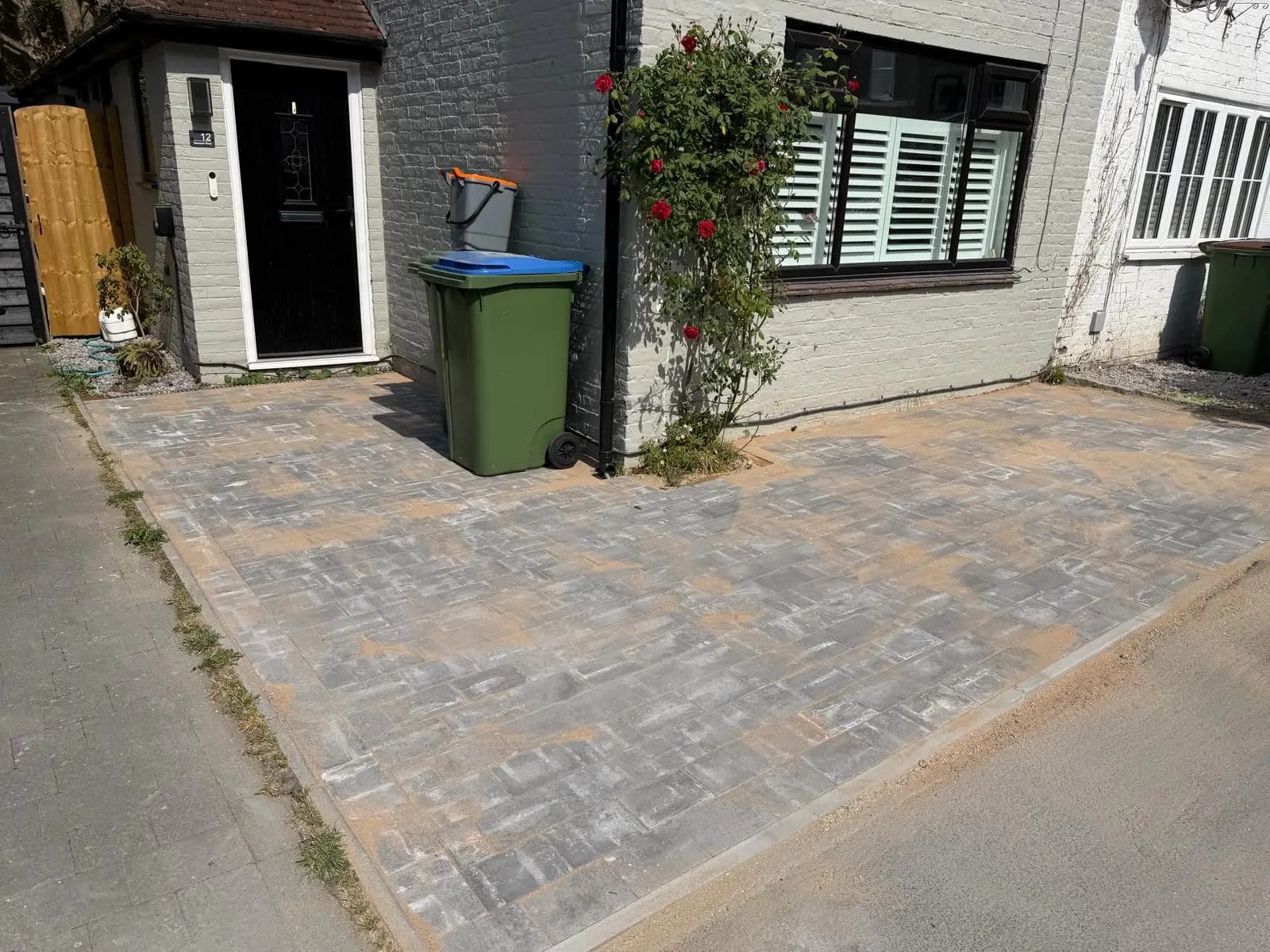
Block paving driveway · Horsham, West Sussex
A small front driveway in tired, weed-grown block paving that had lost its colour. The owners wanted a clean, modern grey block to smarten up the entrance.
The project, start to finish
Tap any photo to view it full size.
The brief
A small front driveway in tired, weed-grown block paving that had lost its colour. The owners wanted a clean, modern grey block to smarten up the entrance.
The work
We lifted the old blocks and prepared the base, set the edges, and laid new grey blocks across the drive, then jointed with kiln-dried sand, brushed in and compacted.
The outcome
A clean, modern grey block paving driveway with crisp edges — a tidy, low-maintenance frontage in place of the worn old blockwork.
This was a block paving driveway project in Horsham, West Sussex. We cover Surrey, UK for residential and commercial surfacing.
How we work
Block paving is the driveway most people picture when they picture a smart drive: a clean, interlocking surface in a herringbone or stretcher pattern, edged crisply against the lawn, that lifts the whole front of the house. Done properly it is also one of the most durable finishes you can lay — the strength comes from thousands of individual blocks locking against each other, not from a single brittle slab that cracks the first time something heavy parks on it.
We measure up, check the existing ground and drainage, and bring block samples to hold against the house. You will know the pattern, colour, and edge detail before we quote.
We dig out to the right depth for the load, lay a geotextile membrane where the ground is soft, then build and compact a Type 1 sub-base in layers — usually 150–250mm.
Blocks are laid on a screeded sharp-sand course to the agreed pattern, with edge courses haunched in concrete. Cuts around manholes and curves are done with a saw, not snapped.
Kiln-dried sand is brushed in and the whole drive is plate-compacted, twice, to lock the blocks. We finish with a walk-through and tell you when to top the joints up.
Questions
Most residential block paving drives take 5 to 10 working days depending on size, access, and how much excavation the ground needs. We give you a day-by-day schedule with the written quote so you can plan around it.
Weeds in block paving almost always grow in debris that settles on top of the joints, not up from underneath a properly compacted base. Regular sweeping and an occasional joint top-up keeps them out; we can also use polymeric jointing sand, which sets firmer and slows growth considerably.
Often, yes. Many Marshalls and Bradstone ranges are still in production, and where a block is discontinued we can usually lift sound blocks from the original to use on the visible areas and put the closest match on the less-seen edges. We will tell you honestly at the site visit how good a match is achievable.
For a driveway under 5m² you do not. Above that, the rules require the surface to be permeable or to drain to a soakaway on your own land — which a standard block drive needs designed in. We handle that within the quote and flag the rare cases where a full planning application is sensible.
A correctly built block paving drive comfortably handles cars, vans, and the occasional caravan or removal lorry — block paving actually outperforms tarmac under concentrated point loads. The key is the sub-base depth, which we set to the heaviest thing you expect to park on it.
Tell us roughly what you'd like done. We'll come out and quote in writing.