

Surfacing in
Guildford
Period homes off the Hog's Back, new builds around the A3 corridor.
See work in Guildford→We will beat ANY like for like quotation. Contact us for more information.
Surfacing in Farnham
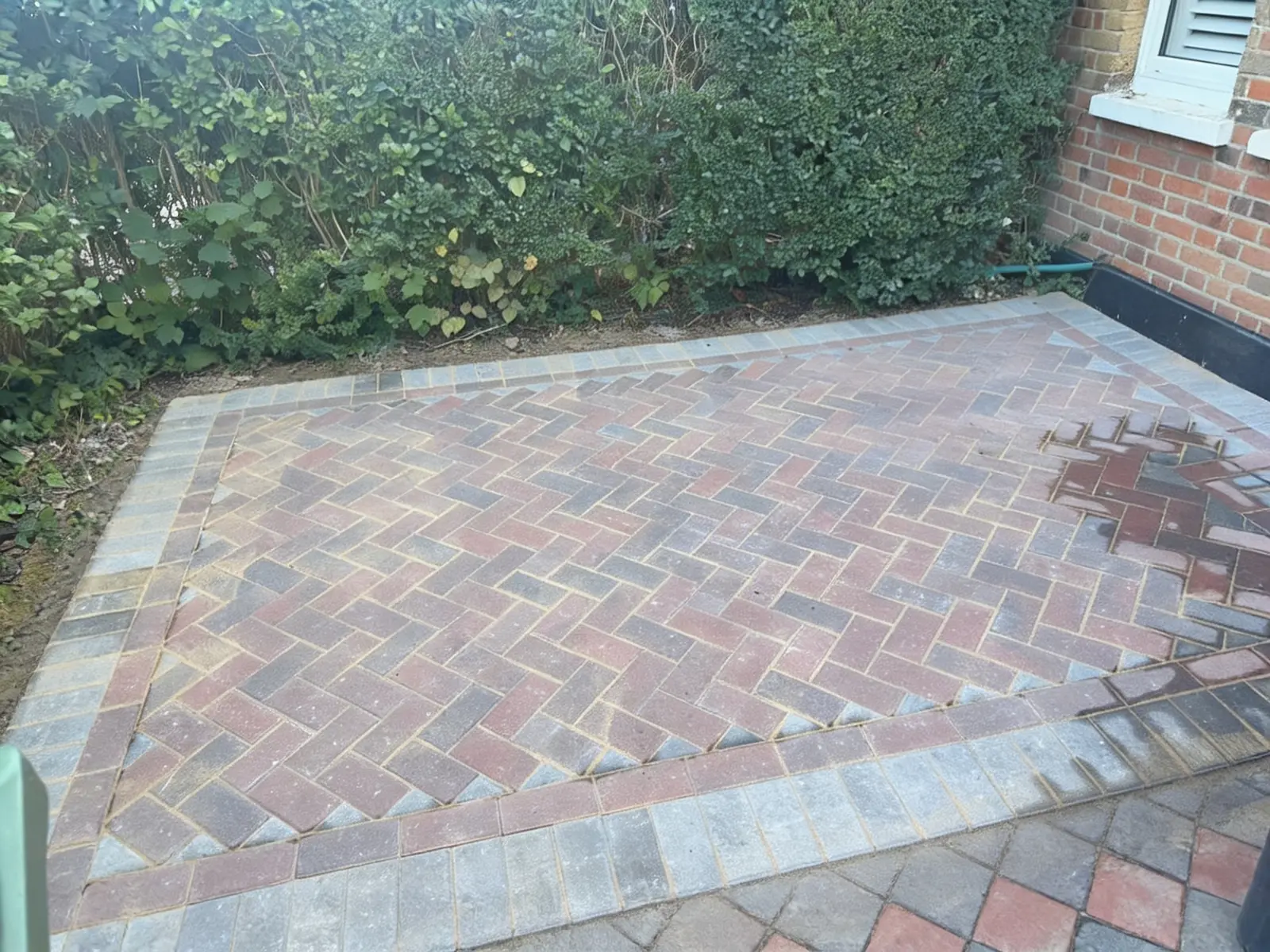
Porcelain, sandstone, and block paving patios and paths. — for Farnham homeowners and properties.
 BeforeAfter
Before & after
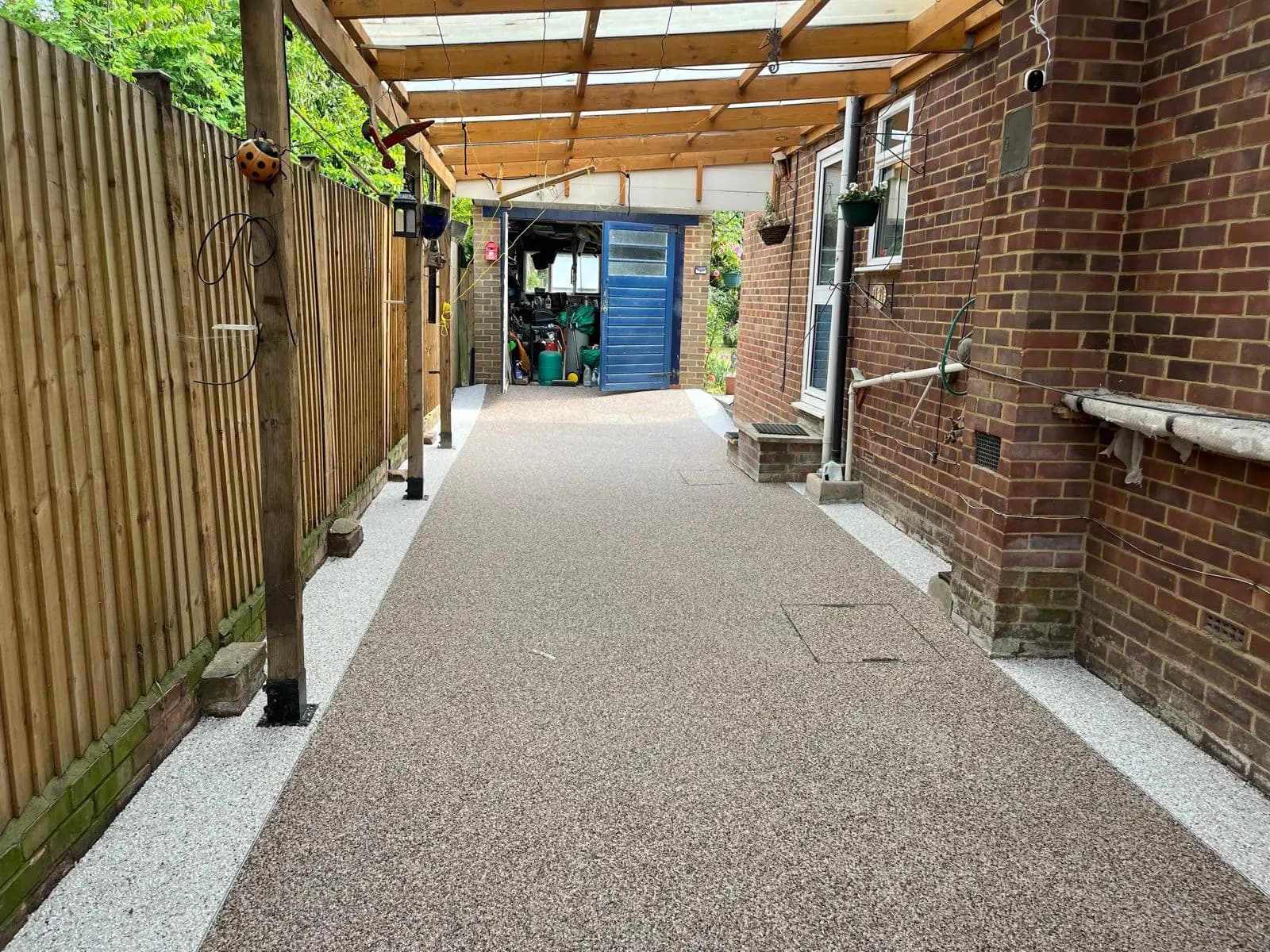
A smooth, low-maintenance silver-grey resin path that runs cleanly along the side of the house — a clear lift from the old, stained concrete.
See the full projectPatios in Farnham
Farnham's gardens reflect the same range as its architecture — from enclosed Georgian-era town gardens behind properties on Castle Street and West Street, to the open rural plots on the lanes between Rowledge and Frensham where the space to work with is considerable. Patios and pathways in both settings live with the weather year-round and are looked at from inside the house every day, which is why the material choice and the quality of the installation matter more here than they might in a less distinctive setting. Getting the falls right from the start, jointing properly for the material, and choosing a surface that suits the age of the house all count.
Conservation area designations cover a significant part of central Farnham, and even on properties outside the formal boundary the local character of the town influences what looks appropriate. Porcelain in a contemporary large format can look very sharp in the right garden, but it sits less easily against a Farnham Georgian terrace than calibrated sandstone or a traditionally laid porcelain in a muted tone does. We bring samples to every site visit and talk through the options honestly rather than just quoting the most straightforward thing to lay.
How we work
We come out, measure up, and talk through what you want.
Spec, schedule, and price in writing — no surprises.
Rip-out, prep, surface. Tidy site each evening.
Walk-through on completion and a call back if anything settles in.
Natural sandstone — calibrated Indian sandstone in Buff, Raj Green, or Kandla Grey — has always suited Farnham's period properties. It has a warmth and variation that works against brick and stone, and on a south or west-facing garden in this part of Surrey it weathers gracefully. The honest maintenance trade-off is that it absorbs water, picks up staining, and grows algae on shaded north-facing areas if it is not sealed after laying. We apply a penetrating impregnator as standard on natural stone once the mortar bed has fully cured, and we tell you when it is worth reapplying.
Porcelain has a different set of trade-offs: it does not stain, moss finds it far harder to grip, and the finish you choose in the showroom is still essentially the finish you have a decade later. The critical installation step that separates a porcelain patio that lasts from one that starts to hollow and lift within two winters is back-buttering each slab with a slurry primer before it meets the mortar bed. Without that bond between the low-suction porcelain face and the bedding mortar, the slab-to-mortar adhesion fails through freeze-thaw cycling. We do not skip this step.
Farnham's position on or near the Greensand ridge means many gardens — particularly on rural plots south of the town towards Rowledge, Bourne, and Frensham — sit on sandy, free-draining ground. That is good for drainage but it also means a patio sub-base needs sufficient depth and a geotextile membrane to remain stable under the point loads that garden furniture and foot traffic apply over years. Sandy ground with a shallow bed below a patio will settle unevenly, and once paving starts to tip it is much harder to relay than to build properly in the first place.
Falls are designed and set at the survey stage, before a single slab goes down. A patio needs to shed water away from the house wall — even a gentle 1-in-80 fall makes the difference between a terrace that dries quickly and one that holds standing water against a render or brick face through autumn and winter. On Farnham's enclosed Georgian town gardens, where the patio is often tight to the rear elevation, this is the most important detail in the whole job.
FAQ
Yes. Patio and pathway work in a garden almost always sits within permitted development regardless of conservation area designation, because it is behind the house rather than on a public frontage. That said, we pay close attention to material and colour choices in and around the conservation area, and we will steer you towards finishes that complement the age of the property rather than contrast with it. If your property has any listed status we will discuss that specifically at the site visit.
It does, and it needs to be addressed rather than ignored. Sandy Greensand soils have low bearing capacity and can settle unevenly under the localised loads a patio takes over time. We specify a deeper compacted sub-base on plots with sandy ground and add a geotextile membrane to prevent the bedding material from mixing with the substrate below. The extra preparation adds a modest cost at the outset and a lot of longevity to the finished patio.
A typical domestic patio runs three to five working days from start to finish, including excavation, sub-base, bedding, and jointing. Pathways are quicker if they are short runs, longer if they connect multiple areas across the garden. We give you a day-by-day programme with the quote so you know when the garden will be accessible again and when you can put furniture out.
Yes. Farnham is within our regular working area. We visit to measure the space, check ground levels and drainage, discuss material options, and bring samples for you to view against the house and garden. You receive a written quote with the full specification — material, bed depth, falls, and jointing — not an estimate based on square metreage alone.
Tell us roughly what you'd like done. We'll come out and quote in writing.
Nearby
Surfacing in
Period homes off the Hog's Back, new builds around the A3 corridor.
See work in Guildford→Surfacing in
From Hook Heath driveways to commercial yards near Sheerwater.
See work in Woking→Surfacing in
Stoke D'Abernon homes and the Fairmile estates.
See work in Cobham→Surfacing in
St George's Hill and Burwood Park resin and block paving.
See work in Weybridge→