

Surfacing in
Guildford
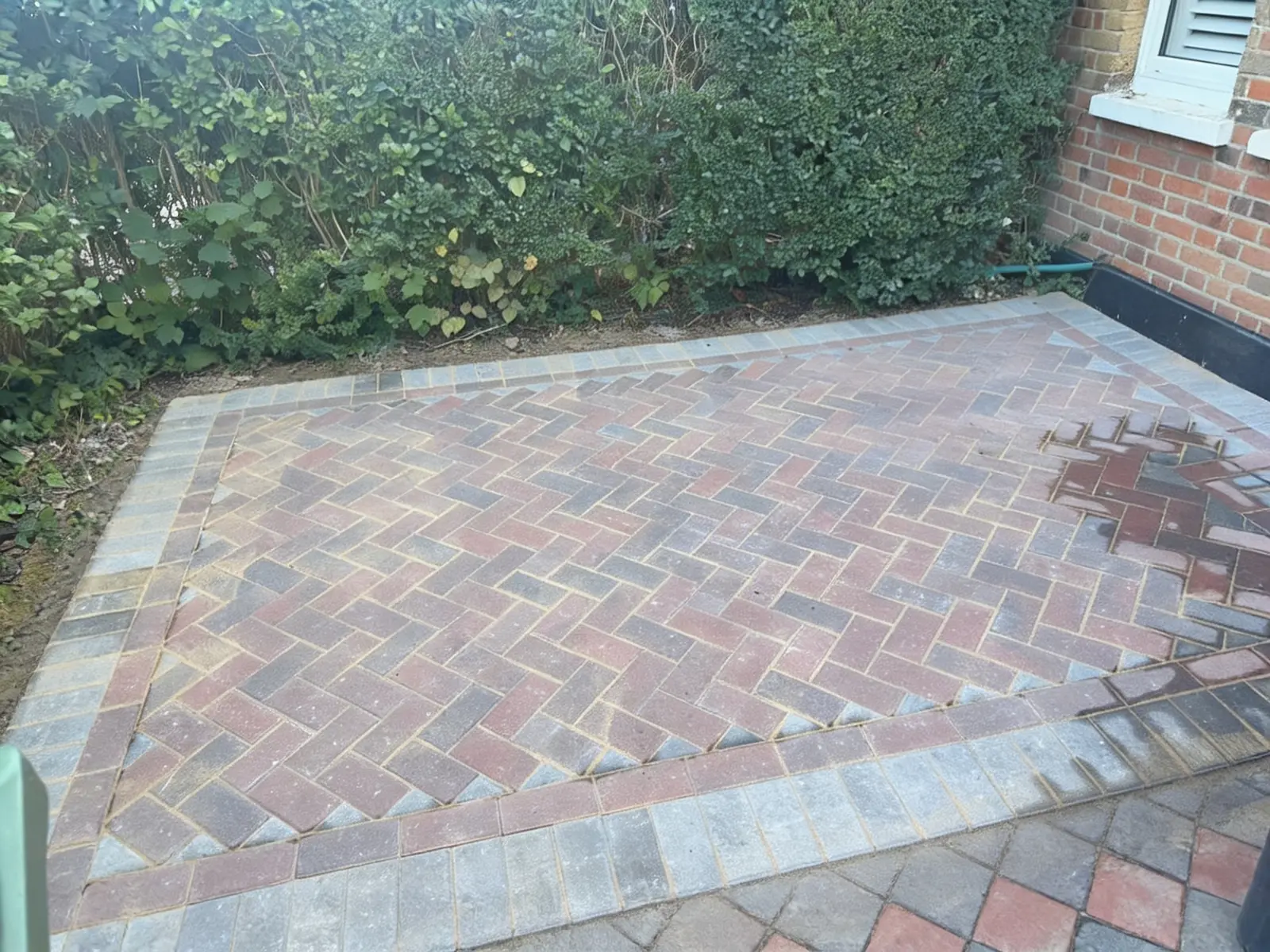
Period homes off the Hog's Back, new builds around the A3 corridor.
See work in Guildford→We will beat ANY like for like quotation. Contact us for more information.
Surfacing in Surrey
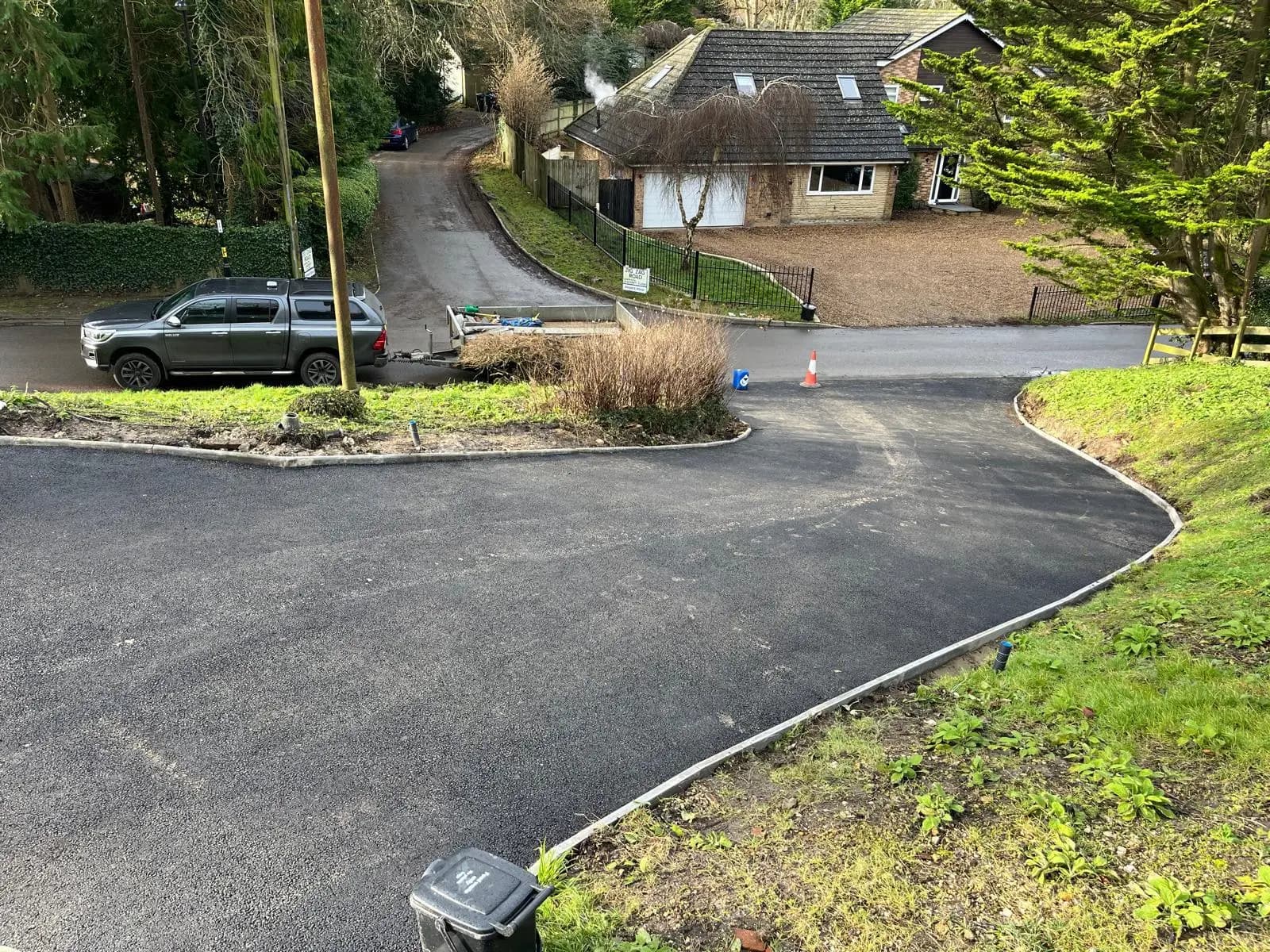
Residential driveways, patios, and commercial work in Epsom and the surrounding area.
 BeforeAfter
Before & after
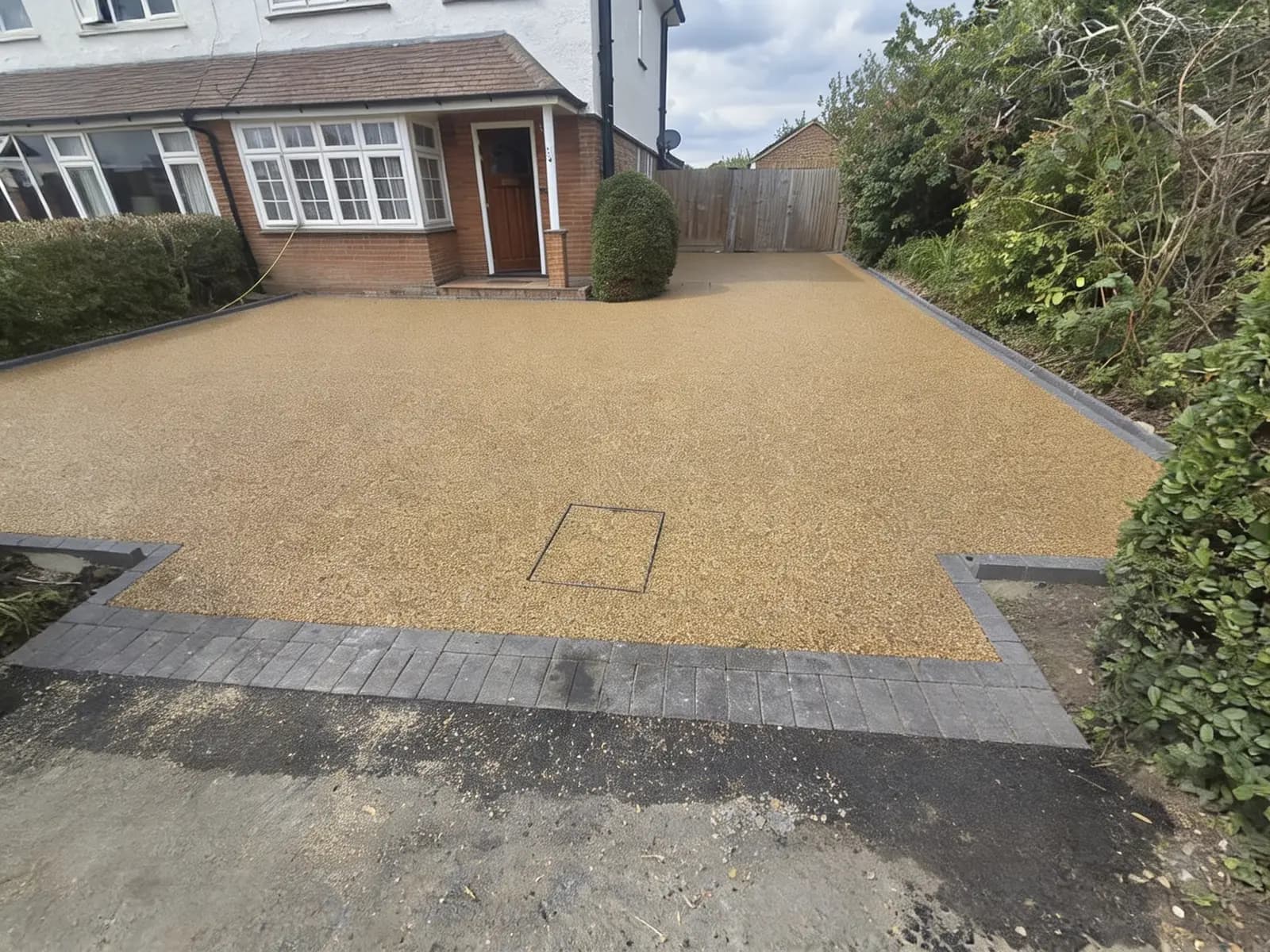
A bright, low-maintenance frontage — a seamless golden resin drive, a crisp curved brick border, and artificial lawn that stays neat year-round, front and side.
See the full projectAbout Epsom
Epsom is a busy, well-connected Surrey town with a housing stock that ranges from inter-war semis in Stoneleigh and Ewell to larger detached properties on the quieter roads near the College and out towards Langley Vale. That variety means we are called to a wide range of driveway sizes and specifications here, from a modest tarmac refresh on a 1930s semi to a full block-paving installation on a substantial plot backing onto the farmland that fringes Epsom Downs. In a single month we might resurface a residential driveway in Ewell, quote a car park for a business near the town centre, and repair a section of private road on one of the older estates.
The chalk geology beneath Epsom Downs and the surrounding area gives the ground here some distinctive characteristics. Where the chalk is close to the surface, drainage is generally excellent and the ground is firm, which means sub-bases tend to perform well without excessive depth. As you move into the lower-lying suburban streets of Stoneleigh and towards the Hogsmill catchment, heavier soils start to appear, and drives in those areas need a bit more thought on drainage and membrane specification.
Epsom racecourse and the Downs are the obvious landmarks here, and the roads that serve them see significant traffic at certain times of year. We have carried out resurfacing and pothole repair work on private roads and car parks in the Downs area, and we understand the logistical constraints that come with sites that have seasonal access restrictions.
Areas we cover in Epsom
Epsom sits at the northern foot of the North Downs, and the chalk that forms the Downs runs close to the surface across a broad band that includes much of Epsom Downs, Langley Vale, and the higher parts of the town. Chalk is a strong, well-draining substrate, and drives built on pure chalk bedrock rarely have drainage problems. The downside is that chalk can be hard to excavate when the overburden is thin, so site preparation can take longer than on softer ground.
Closer to Stoneleigh and the Hogsmill valley, London clay starts to influence the soil profile. Clay soils hold water and expand and contract with seasonal moisture changes, which places repeated stress on a surface and its base. On drives in these areas we specify a geotextile membrane between the sub-base and the subgrade, and we pay close attention to the fall and drainage of the finished surface. If a drive already shows cracking along the edges or low spots that hold water, clay movement is often the cause.
The inter-war and post-war semis of Stoneleigh and West Ewell typically have front drives of 20 to 40 square metres, large enough to park two cars comfortably when the specification is right. These properties often have original concrete or tarmac surfaces that have been patched repeatedly rather than replaced, and the result is a lumpy, stained finish that is difficult to clean and does not do the house any favours.
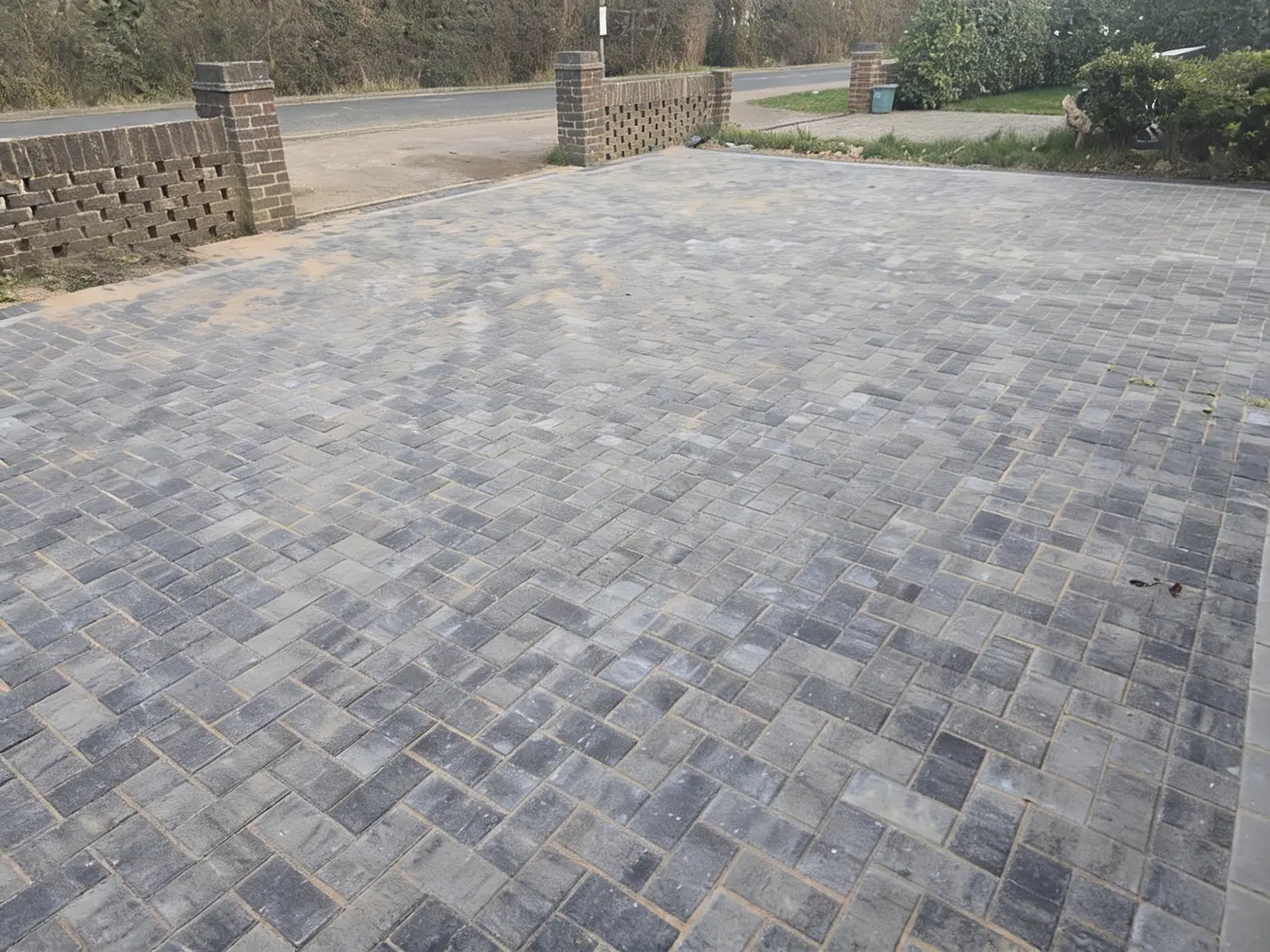
The most popular replacement choice on these properties is resin-bound surfacing: it looks clean and contemporary, is permeable so it meets the current SuDS rules without extra drainage work, and does not require the same maintenance as block paving with sand joints. On the older detached houses around the College and in Ewell Village, where the property has more architectural character, block paving in a traditional bond and colour tends to look more at home. We talk through the trade-offs at every site visit and can show you samples of both.
Surfacing in Epsom
Chalk is actually a very good substrate for driveways: it is strong, drains well, and does not heave with seasonal moisture changes the way clay does. The main consideration is that hard chalk can make excavation slower when the overburden is thin. We factor this into the quote and will tell you at the site visit if the ground conditions are likely to affect the programme or cost.
Edge cracking on drives in the Stoneleigh and West Ewell area is often related to clay subgrade movement or, on older drives, an edge that was never properly restrained. Clay expands when wet and contracts when dry, and a shallow or unrestrained base cannot accommodate that movement indefinitely. The right fix is to excavate to a proper depth, install a geotextile membrane, and rebuild with adequate edge restraint rather than patching the cracks repeatedly.
Yes. We cover Ewell, Ewell Village, Stoneleigh, West Ewell, Langley Vale, and the properties around Epsom Downs and the College. If your address is on the edge of our area or you want to confirm before arranging a site visit, give us a call and we will let you know.
For a typical inter-war semi, resin-bound surfacing is the most popular choice at the moment because it looks tidy, drains through itself, and needs very little upkeep. If the house has more traditional character or you prefer a finish with individual units you can lift and relay later, block paving is the stronger option. Cost-wise the two are close. We show you samples and talk through both at the site visit so you can make an informed decision.
Tell us where you are and what you'd like done. Free site visit, written quote.
We also cover
Surfacing in
Period homes off the Hog's Back, new builds around the A3 corridor.
See work in Guildford→Surfacing in
From Hook Heath driveways to commercial yards near Sheerwater.
See work in Woking→Surfacing in
Stoke D'Abernon homes and the Fairmile estates.
See work in Cobham→Surfacing in
St George's Hill and Burwood Park resin and block paving.
See work in Weybridge→Surfacing in
Claygate, Hinchley Wood, and Esher village driveways.
See work in Esher→Surfacing in
Conservation areas and rural plots around the town.
See work in Farnham→